Witches, Gender, & the Family
The witchfinder John Stearne noted that there were more female witches than male in his demonology A Confirmation and Discovery of Witchcraft, written in 1648 after he had retired from witch-hunting. He stated this was because women were easily misled by the Devil, impatient, more malicious and vengeful than men, more tyrannical, likely to teach their children witchcraft, and had a closer relationship with the Devil than men did because the first woman Eve had been tempted by the Devil.
Misogyny was certainly a major factor behind witchcraft accusations. What did it mean, then, when a man was accused of witchcraft?
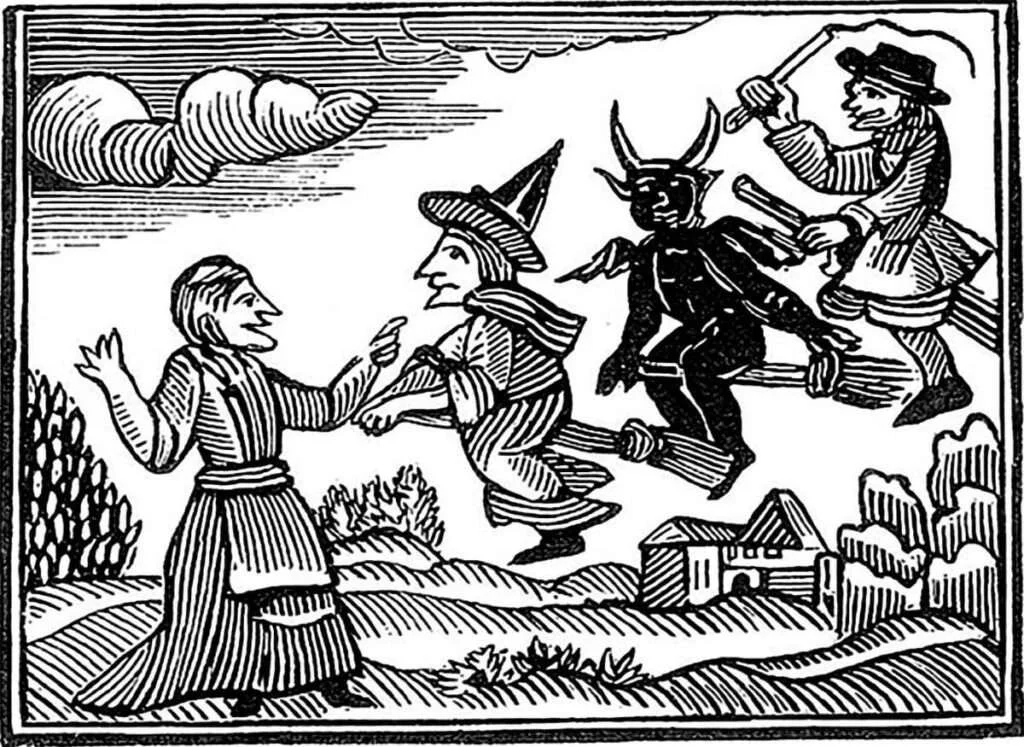
Pictured: woodcut depicting male and female witches
The first ‘witches’ convicted in the East Anglian trials at Chelmsford in July 1645 had all been women. But once John Stearne and Matthew Hopkins entered Suffolk that same summer, they began investigating male suspects. Of the 133 accused Suffolk witches whose sex is known, 21 were men, or 16% — a minority, but not an incidental number.
John Lowes, the controversial parson of Brandeston who was accused by his own parish, was understood by his accusers as embodying the violence, tyranny, and malice they associated with witches. These traits can be understood as an excessive masculine exertion. Rather than being a leader (positive masculine trait), he was a despot (overly masculine trait) who relied on aggression and even physical strength to keep his parish in line (again, excessive manliness).
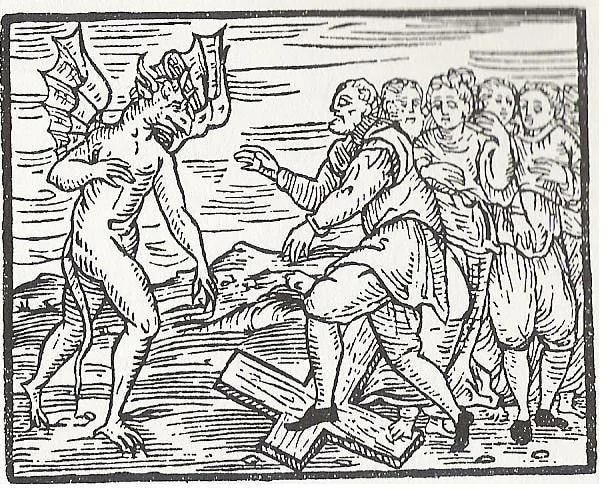
Pictured: woodcut of a male witch trampling the cross
Worse, Lowes had transgressed the expectations of his role as a spiritual patriarch. Lowes was meant to be his congregation’s symbolic father and connection to God the Father. Yet rather than guide his flock, he had bewitched them and jeopardized their very souls. In early modern English society where the patriarch was the ultimate figure of authority, this was a shocking and horrific insinuation.
It is also worth remembering that Lowes’ conviction coincided with the ongoing First English Civil War, with Parliament risen against Charles I ,and the conflict’s larger questions of what it meant for a man to be a leader versus a tyrant.
While Lowes can be understood as violating expectations of manhood through excessive aggression and abuse of his authority, other male witches were described in their confessions or accusations against them as taking on feminine traits. This does not mean these individuals were literally seen or identified as women, or as homosexual, but that they became associated with femininity.
The male witches of East Anglia were often depicted as foolish, weak-willed, petty, and emotional —all traits that were associated in early modern England with women. They might be further emasculated through failing to provide for themselves financially and being reliant upon the Devil for money or power.
East Anglian male witches were also described as physically taking on perceived feminine traits through nursing imps.
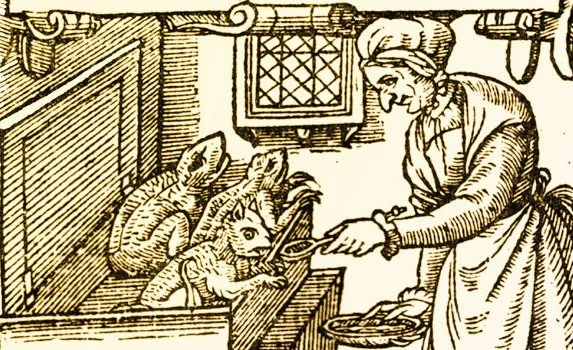
Pictured: woodcut of female witch feeding imps
Witches were thought to feed their blood to imps, or demons, that took on the shape of small domestic animals or vermin.
As described in John Stearne’s A Confirmation, female witches regularly referred to their imps as their children, and the nursing of imps can be understood as a perversion of a mother breastfeeding her infant milk.
A male witch nursing his imps would have been understood by contemporaries as a further inversion of the maternal bond. Several East Anglian male witches, including John Lowes, are described as keeping or nursing imps.
The most evocative of these cases is that of John Bysack of Waldingfield. Bysack kept six imps in the form of snails, distinguishable from one another by their size and colour, that visited him once a week or fortnight for twenty years. As described in A Confirmation:
[Bysack] said he used to lie down on his right side to let [his imps] suck, and was willing withal: for he confessed he oftentimes arose out of his bed, and made a fire, and lay down by it to let them suck his blood
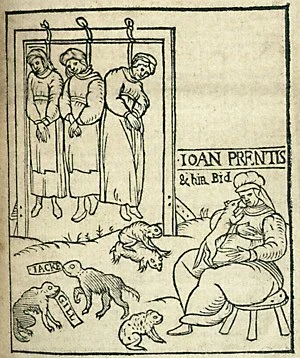
Pictured: woodcut of female witch nursing and tending to imps while three witches hang
Bysack’s ritual of leaving his bed in the middle of the night to nurse his imps by the fire is reminiscent of a mother waking at night to tend to her hungry infant. The twenty-year relationship between Bysack and his familiars suggests both a physical intimacy through the act of suckling and an emotional bond through the recognition of each imp as an individual. The relationship was built on Bysack’s ability to feed the imps blood in the same way a child-mother relationship centred on the mother’s provision of milk.
Bysack’s fate is unclear.
Suffolk’s male witches can also be interpreted as female-related quite literally through being the family members of suspected female witches. It was common for the children or relatives of suspects to be likewise accused. Two mother-daughter pairs were accused at the Chelmsford trials in July 1645, the first accused witch Elizabeth Clarke was the daughter of a convicted witch, and Margaret Moone’s daughters were accused by Margaret herself, among other examples of East Anglian witch-families.
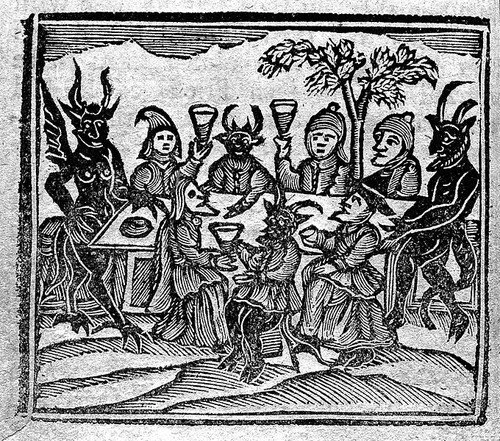
Pictured: woodcut depicting male and female witches with demons
Alexander Sussums of Long Melford, a former acquaintance of John Stearne, confessed to feeding imps and requested for Stearne to search him. When Devil’s marks were found on Sussums, he claimed he could not help being a witch because his mother, aunt, grandmother, and other ‘kin’ had all been witches. It is notable he does not mention any male relatives who were witches.
Sussums was ultimately not charged, to Stearne’s dismay.
The ‘Rattlesden boy’, a child-witch under nine years old whose name is unknown, came to be suspected of witchcraft after his mother was accused. He allegedly caused some minor mischief with chickens and was imprisoned, with Stearne noting he had little hope the boy would ‘reform’. Thomas Everard of Halesworth was accused alongside his wife, daughter, and brother-in-law. Thomas Everard was executed with his wife at Bury St Edmunds in August 1645. His daughter was freed and his brother-in-law’s fate is unknown.
These three cases demonstrate men who became suspected after or alongside their female relatives, suggesting a strong perceived affinity between the man and his female relations at a time when men were normally defined by their familial relationships to other men.
With 84% of the accused Suffolk witches whose sex is known being female, gender was clearly a significant factor in rendering a person vulnerable to accusation. Yet the Suffolk male witches demonstrate that the relationship between gender and witchcraft accusations was complex. Men could be accused through excessive manliness or alternatively through strong association with femininity, with both being a violation of expected behaviour for men.
Further reading.
Malcolm Gaskill, “Masculinity and Witchcraft in Seventeenth-Century England.” in Rowlands, A. (eds) Witchcraft and Masculinities in Early Modern Europe (London, 2009)
Malcolm Gaskill, Witchfinders: A Seventeenth-Century English Tragedy. Harvard University Press, 2005
E.J. Kent, "Tyrannical Beasts: Male Witchcraft in Early Modern English Culture", in Emotions in the History of Witchcraft, edited by Laura Kounine, and Michael Ostling, Palgrave Macmillan UK, 2017
Kelsey Norris, “Witchfinders and Male Witches: Masculine Norms in the East Anglian Witch Trials, 1645-47” [MA thesis]
John Stearne, A confirmation and discovery of witchcraft (London, 1648)
Deborah Willis, Malevolent Nurture (New York, 1995)