Suffolk’s Child-Witch
There was no shortage of suspected Suffolk witches for the witchfinders Matthew Hopkins, later known as the “Witchfinder General, and John Stearne to investigate — women, men, and even children.
John Stearne in his demonology A Confirmation and Discovery of Witchcraft, published in 1648 after he retired from witch-hunting, relates his encounter with a child-witch identified only as a ‘Boy in Ratlesdon’. The child was “under nine yeares of age”, making him the youngest person known to have been investigated as part of the East Anglian witch trials.
Female witches were thought to initiate their children into witchcraft from a young age, but such children were rarely prosecuted in England as they were presumed to be too young to cause harm. It was more likely these children would be coerced into testifying against their families. That the Rattlesden Boy would be prosecuted is unusual and demonstrates the intensity of the witch-panic in Suffolk.
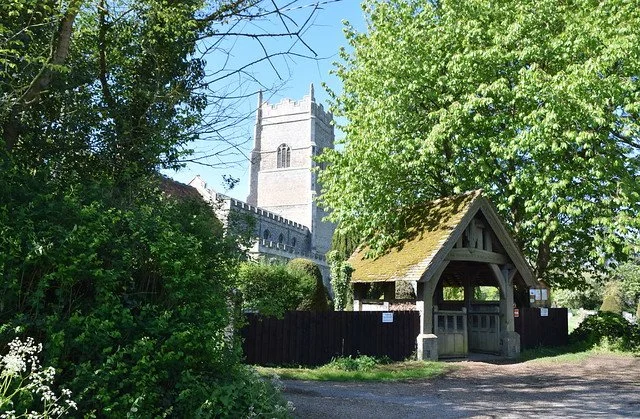
Pictured: St Mary’s Church, Rougham, which the Rattlesden Boy and his mother would have attended
The Rattlesden Boy was originally from Rougham near Bury St Edmunds.
It is likely his mother, name not recorded, was first to be suspected of witchcraft and that her young son came under scrutiny through association. However, the timeline is unclear as to which was suspected first.
John Stearne questioned the Boy (and possibly also his mother) in the summer of 1645. A Confirmation stresses that the Boy was not deprived sleep but “voluntarily confessed” — however, this was a young child separated from his mother, arrested, and interrogated by adults who held complete control over him, so his confession was by no means given freely or with the full understanding of its’ implications. The Boy admitted to keeping an imp and to minor mischiefs. The mother was convicted and hanged in the autumn at Bury St Edmunds, but the jury had found that the Boy “had hopes of…amendment” and released him.
The Boy found himself in Rattlesden, six miles from Rougham, by 1646. It is likely that he was driven out of Rougham due to his reputation and then either stayed with relatives in Rattlesden or was rough living. There is no mention by Stearne of the Boy’s father, leaving the possibility the Boy was illegitimate or the father was otherwise uninvolved. If the Boy was homeless, and perhaps reliant on begging or stealing to survive, it would have given his new Rattlesden neighbours further reason to resent and be suspicious of him.
Unfortunately, the Boy again encountered John Stearne around April 1646. Stearne was visiting Rattlesden for the second time when he was informed that the Boy had been causing trouble again.
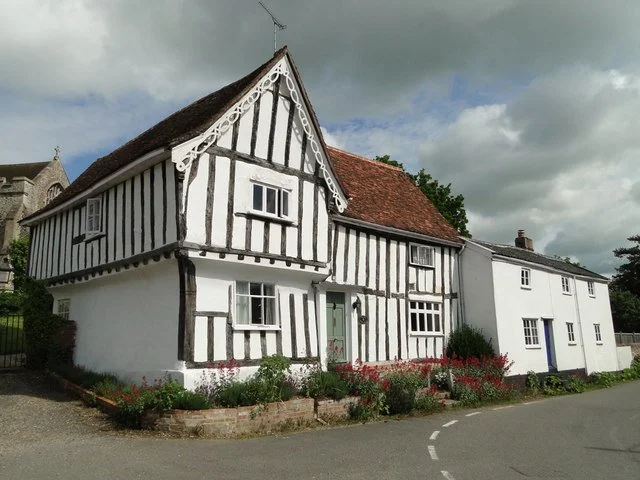
Pictured: the Moot Hall, Rattlesden, where John Stearne may have interrogated suspects on his visits in 1645 and 1646
The Boy confessed to witchcraft again and that the Devil appeared to him “in the likenesse of a black browne Mare, and would carrie him whither hee desired” — a terrified child’s fantasy of freedom and safety somewhere far, far away.
The child was held in the Bury St Edmund’s gaol to await his trial.
As the trials’ date approached over the summer of 1646, another prisoner escaped from the gaol. The escaped prisoner was a “notorious offender” who was kept double-shackled in the same cell as other male prisoners, including the Rattlesden Boy. There was evidently no separation of prisoners based on accused criminal offence, meaning the Boy may have been confined with genuinely dangerous adult men.
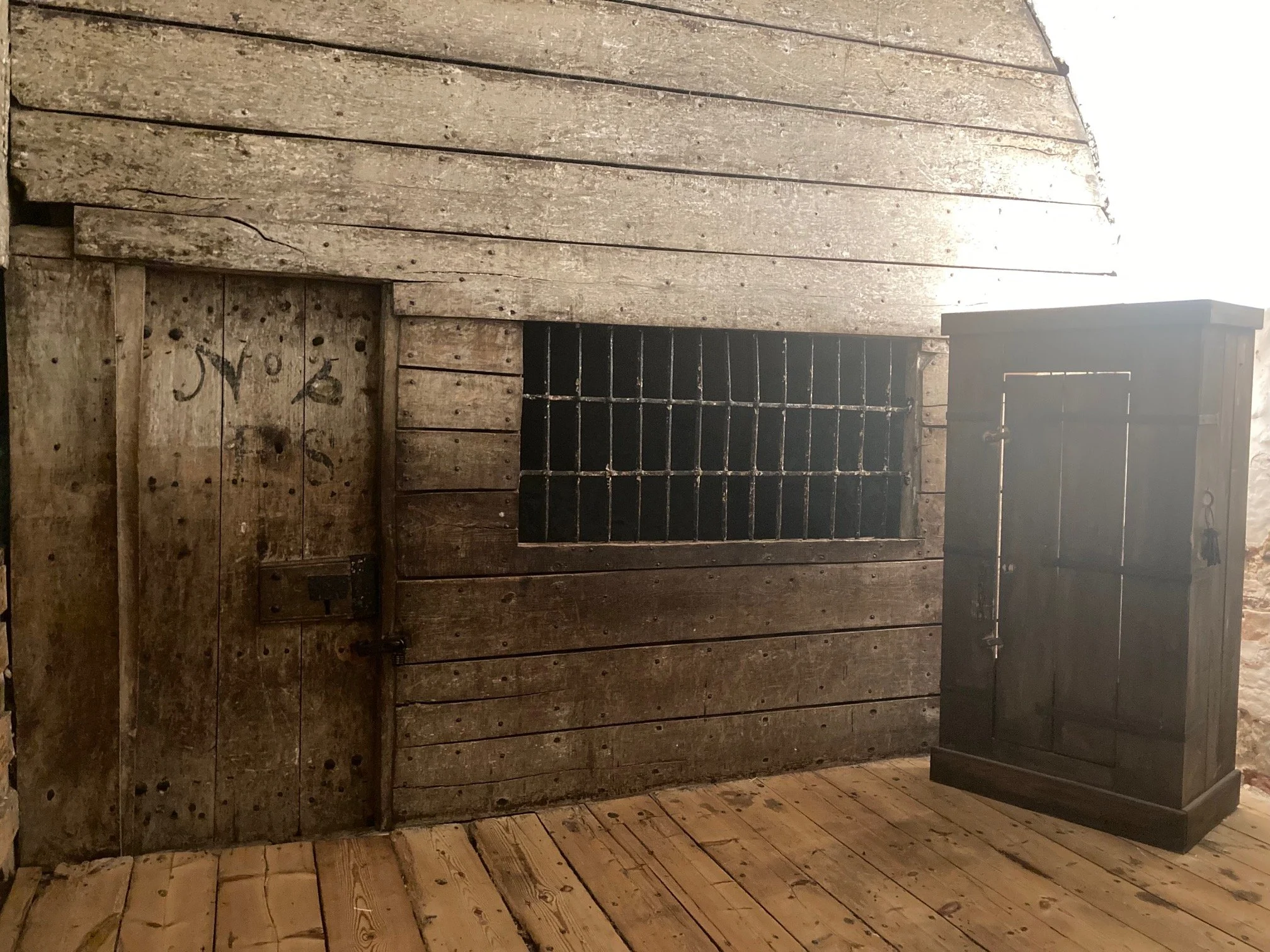
Pictured: recreation of a seventeenth-century gaol similar to the one at Bury St Edmunds, at Colchester Castle
The panicked gaoler saw the Boy as an opportunity to discover where the man had gone. The gaoler interrogated him and made “threatening speeches”. The frightened Boy showed them where the prisoner had made his escape and said that he had gone home to his wife. The Boy further claimed that the man had escaped on the Boy’s devil-mare. No one seems to have questioned why the Boy would not have used the mare to flee himself. The escaped prisoner was found at his wife’s home and taken back to gaol.
The Rattlesden Boy then disappears from the historical record.
Stearne’s A Confirmation was published in 1648, two years after the Boy was in prison awaiting trial. Stearne often included in his descriptions of witches whether they were convicted. That he last described the Boy as being in prison may mean the Boy was still in gaol in 1648. It may also suggest that Stearne simply lost track of the Boy and didn’t know what became of him.
It seems unlikely that a child would have been executed, especially as popular opinion began to turn against the witch trials in 1646. Critics likely would have used the child’s execution as a major point in their condemnation of the witchfinders; yet there is no reference to the Boy in any surviving sources. The Boy may have died in gaol from illness, neglect, or abuse. Or the Boy may have been released from gaol, though that did not necessarily mean a happy ending. If the Boy did survive gaol, his best hope would have been to somehow find the means to travel far enough to escape his reputation for witchcraft, though even this could do nothing to erase the trauma of losing his mother, imprisonment, abuse, and neglect.
The story of the Rattlesden Boy illustrates the suffering the witch trials could inflict on the most vulnerable people.
Further reading.
Malcolm Gaskill, Witchfinders: A Seventeenth-Century English Tragedy. Harvard University Press, 2005
Kelsey Norris, “Witchfinders and Male Witches: Masculine Norms in the East Anglian Witch Trials, 1645-47” [MA thesis]
John Stearne, A confirmation and discovery of witchcraft (London, 1648)