Essex Hunting Grounds
Spring and Summer 1645.
The last recorded execution for witchcraft in England before 1645 was in 1626. In the intervening nineteen years, fewer cases had been brought to trial and those that were usually ended in acquittal. But in the spring and summer of 1645, the Tendring Hundred, today the Tendring District, cried witchcraft.
Why 1645? One explanation is the ongoing Civil War. The first Civil War began in 1642 and would end in 1646, coinciding with the bulk of executions in the East Anglian witch trial which took place in 1645. This was a time of genuine terror, bloodshed, religious and social conflict, and death. Wartime anxieties lay heavy on the minds of both legal officials and the common folk. This intensified ongoing local disputes between neighbours and allowed old suspicions of witchcraft to re-emerge.
Once it became widely known that witches had been discovered in Manningtree, and that there were magistrates eager to prosecute witchcraft, other towns and villages followed with their own accusations.
Fifteen Essex towns and villages are known to have been involved in the East Anglian witch trials of 1645. Manningtree, Mistley, Lawford, and Colchester have been covered in prior blog posts here and here.
The Sokens Witches
Five women from the Sokens settlements of Thorpe, Kirby, and Walton (today Walton-on-the-Naze) were accused of witchcraft in 1645.
Margaret Moone of Thorpe was accused of killing livestock, setting lice on her neighbours, and killing a child by giving the family poisoned apples. Deprived of sleep and harshly questioned, she confessed and accused her two daughters. One daughter, Judith, was questioned but released.
Margaret retracted her confession before the magistrates and pleaded not guilty at the Chelmsford Assizes on July 17, but was found guilty. She died the next day en route to the gallows, perhaps collapsing out of fear.

Today there is a commemorative bench and signpost dedicated to Margaret Moone and the other Sokens accused at Walton-on-the-Naze, part of the Tendring Witch Heritage Trail.
Alresford, Wivenhoe, St Osyth
One woman from Alresford, two from Wivenhoe, and five from St Oysth were accused.
Another two Wivenhoe women acted as search-women in the 1645 witch-hunt. In the East Anglian witch trials, witches were identified in part through locating Devil’s marks, or witch’s marks, on their bodies. In England, female suspects could only be examined by other women, so search-women played a crucial role in gathering ‘evidence’ against female suspects. Other search-women hailed from Manningtree and other settlements in the Tendring Hundred.
St Osyth had a history of witch accusations prior to 1645. In 1582, thirteen women and one man from St Osyth and the nearby communities were accused of witchcraft. Two women were executed. The 1582 St Osyth trials parallel the later 1645 witch-hunt. Both Ursula Kemp, a St Osyth witch executed 1582, and Elizabeth Clarke, a Manningtree witch executed 1645, had illegitimate children. It is likely their unwed status contributed to their community demonizing them as witches. Brian Darcy, the magistrate who spear-headed the 1582 trials, has been speculated to have been a forerunner of the 1645 witchfinders Hopkins and Stearne. Darcy’s notes formed the basis of a pamphlet on the St Osyth trials, just as Hopkins and Stearne would publish pamphlets on the East Anglian trials based on their experiences in 1647 and 1648.
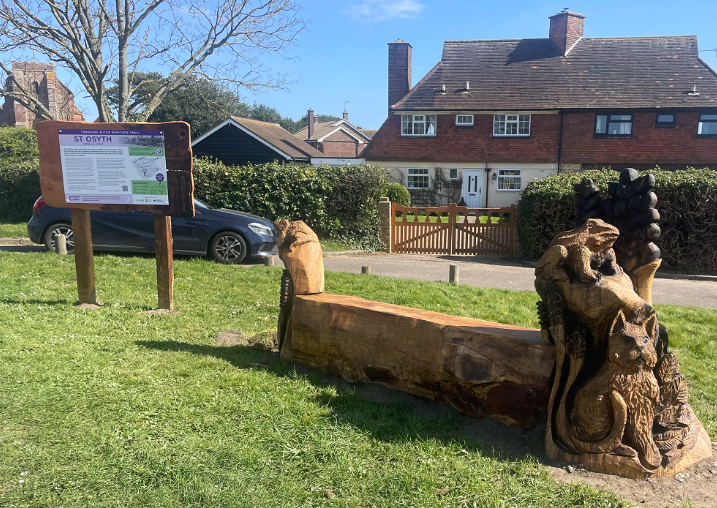
Today there is a commemorative bench and signpost in St Oysth dedicated to Ursula Kempe and the others accused, part of the Tendring Witch Heritage Trail.
St Clere’s Hall, the home of Brian Darcy, still stands though it is now a private residence. ‘The Cage’ is the nickname given to a local building that once served as a prison cell and where Ursula Kempe was allegedly imprisoned, though there is no evidence to prove this and the site’s claims of being haunted may have more of local legend than historical truth to it. More information can be found at the St Osyth Museum’s website, including the story of a skeleton that was mistakenly identified as belonging to one of the 1582 witches.
Ramsey, Great Clacton, Great Holland, Langham, Leigh
Three women from Ramsey, five from Great Clacton, three from Great Holland, three from Langham, and one from Leigh were accused.
Joan Rowle from Leigh was the only accused in 1645 who was not from the Tendring Hundred, so it is presumed that her arrest was unrelated and only by chance coincided with the mass Tendring witch-hunt. This assumption is supported by the fact she was the only individual (other than Rebecca West, who was not made to stand trial and released on account of turning Crown witness against the other women) acquitted.
One other woman was held at Colchester Castle in summer 1645 on charge of witchcraft, Dorothy Brooke, but her origin is not recorded. Dorothy’s trial was postponed indefinitely and she was still imprisoned at the castle in 1648 —her further fate is unknown.
The Essex women, thirty-six in total, were taken to Chelmsford in July 1645 to determine their fate at the assizes.
Further reading.
A true and exact relation of the severall informations, examinations, and confessions of the late witches, arraigned and executed in the county of essex. (London, 1645)
C.L’Estrange Ewen, Witch Hunting and Witch Trials (London, 1929)
Marianne Hester, Lewd Women and Wicked Witches : A Study of the Dynamics of Male Domination (1992)
Malcolm Gaskill, Witchfinders: A Seventeenth-Century English Tragedy (Harvard University Press, 2005)
Marion Gibson, The Witches of St Osyth: Persecution, Betrayal and Murder in Elizabethan England (2022)