Visit Manningtree
Today, Manningtree is a charming small town (one of England’s smallest!) known for it’s Georgian and Victorian buildings, but in 1645 it was the origin ground for what would become England’s largest witch-hunt.
Manningtree is approximately 60 miles outside London and has two nearby train stations, Manningtree and Mistley. How you approach this guide will depend on which station you are arriving at or if you are visiting by other travel means. If you are driving, I recommend parking at the free Kiln Lane car park if there is space.
Manningtree and the nearby villages of Mistley and Lawford can be seen in a few hours by walking, but I recommend leaving additional time to check out the local cafes and shops.
Manningtree
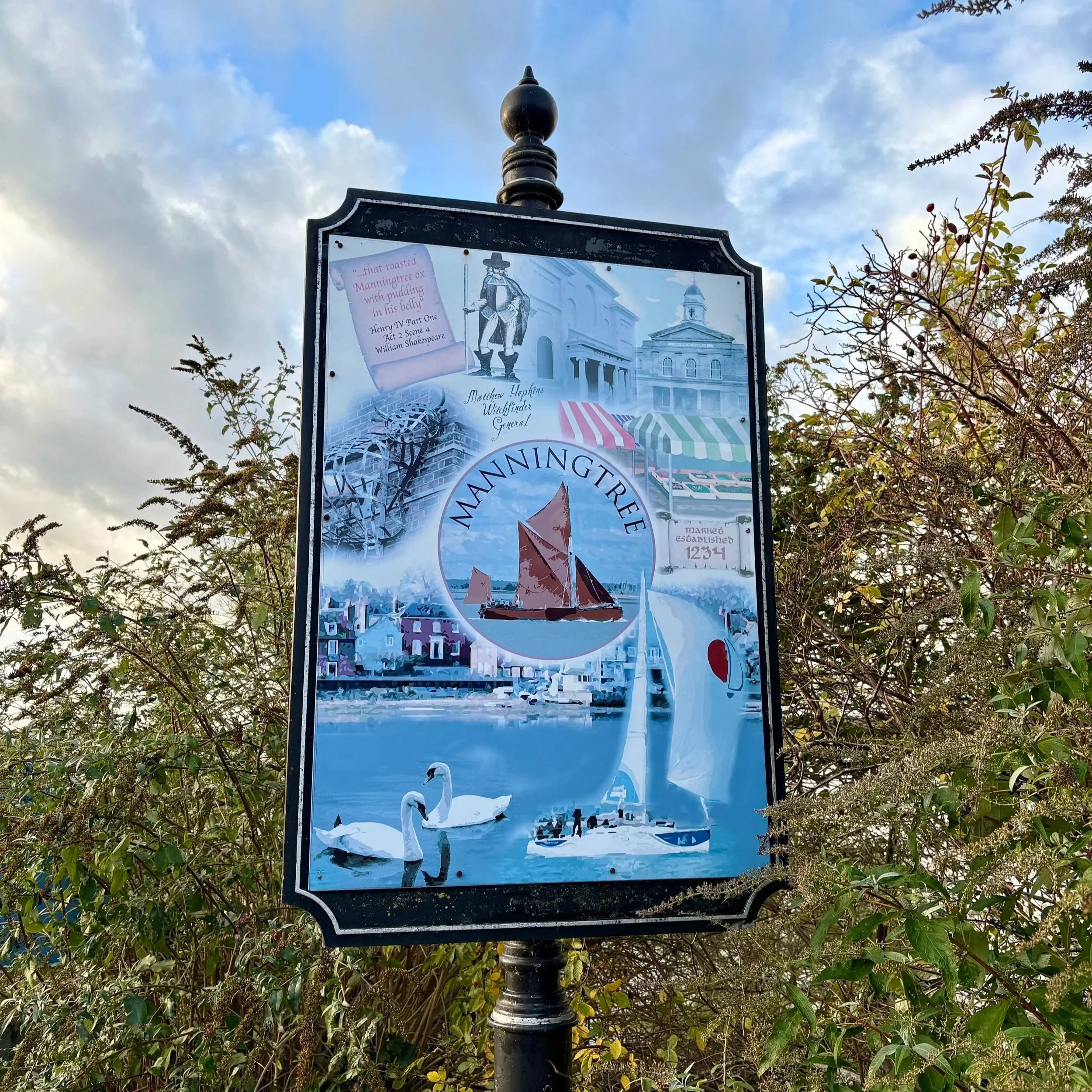
Town Sign
The Manningtree town sign features various images associated with the town’s history, including an engraving of Matthew Hopkins (top off-centre). Hopkins was one of the main proponents of the East Anglia witch trials and would be remembered in infamy as the ‘Witchfinder General’.
Hopkins moved to Mistley (adjacent to Manningtree) as a teenager upon his mother’s remarriage.
Hopkins was involved in the questioning of the first suspected witch, Elizabeth Clarke, in March 1645. He would go on to pursue alleged witches across East Anglia.
Located across from Kiln Lane Car Park.
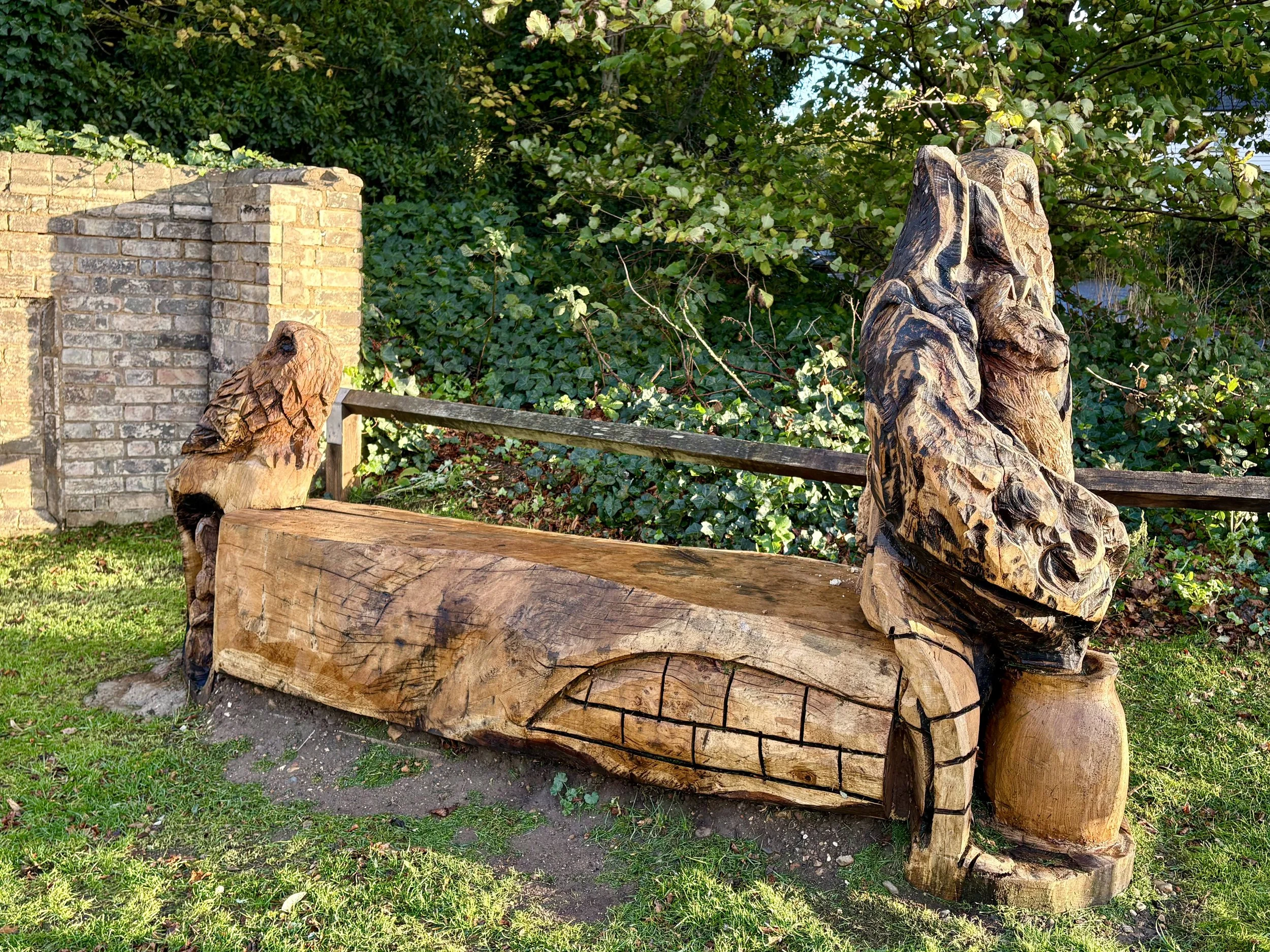
Elizabeth Clarke Memorial
This commemorative bench was unveiled in 2025 as part of the Tendring Witch Heritage Trail.
It depicts the kitchen and imps (demon servants) of Elizabeth Clarke, the first woman to be accused of witchcraft in Manningtree in March 1645. Elizabeth was a thirty-nine year old disabled and poor woman with a young illegitimate daughter. She confessed after harsh interrogation that would be considered torture today. She was executed in July 1645 at Chelmsford.
The memorial bench is accompanied by an information board and AR experience using the Zappar mobile app.
Located in front of Kiln Lane Car Park.
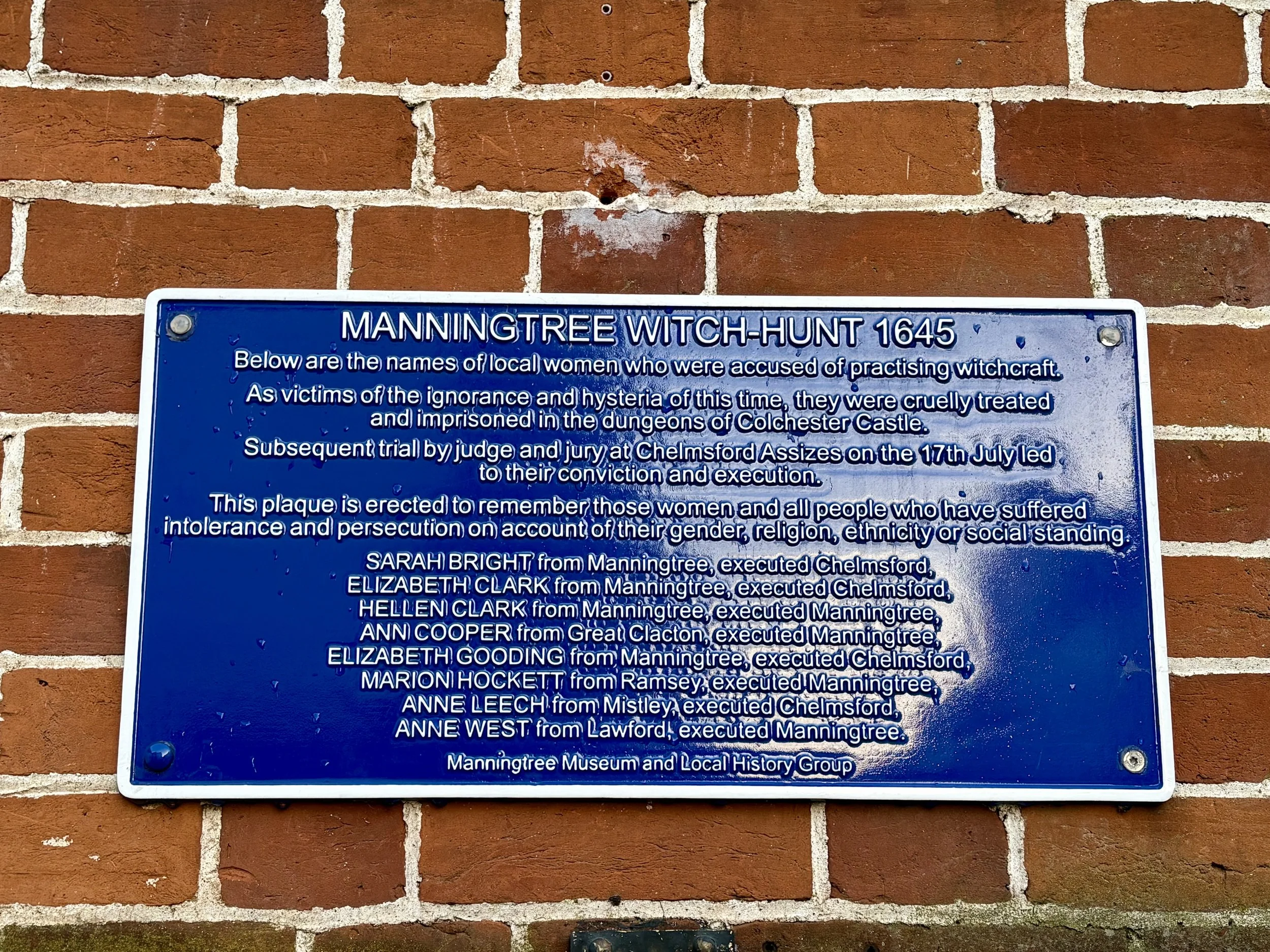
Victims Plaque
Plaque commemorating the local women who were executed for witchcraft in 1645.
Nineteen Essex women in total were executed as part of the July 1645 Chelmsford trials — fifteen at Chelmsford (including Elizabeth Clarke) on July 18 and four at Manningtree on August 1.
Located on the corner of High St and South St, beneath the ‘Manningtree Ox’ art installation.
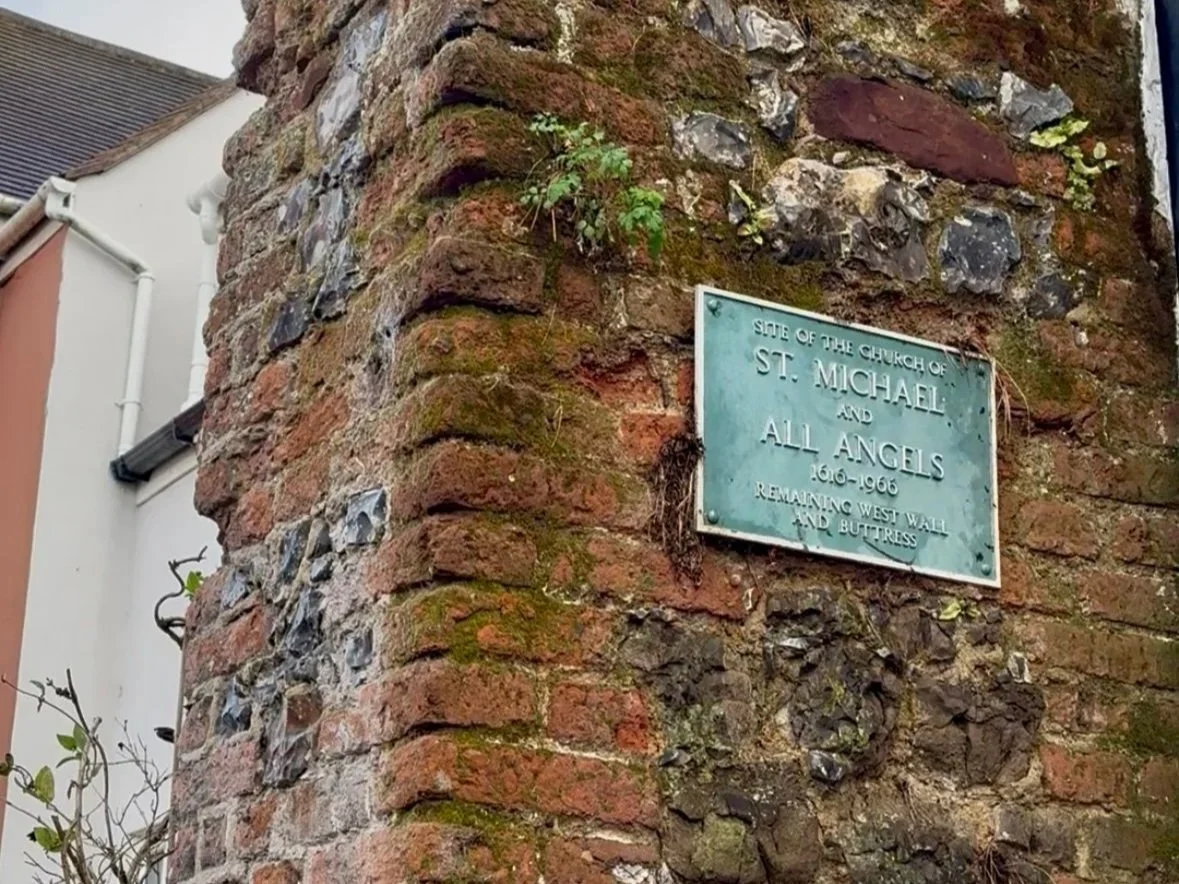
No. 42a High Street
(Former Site of the Church of St. Michael and All Angels)
The church was built in 1616 and served as a place of worship for both accused witches and witchfinders in March 1645.
Today, all that remains is the west wall and buttress, which has a plaque affixed to it.
Located at 42a High St, across from Lucca Italian restaurant.
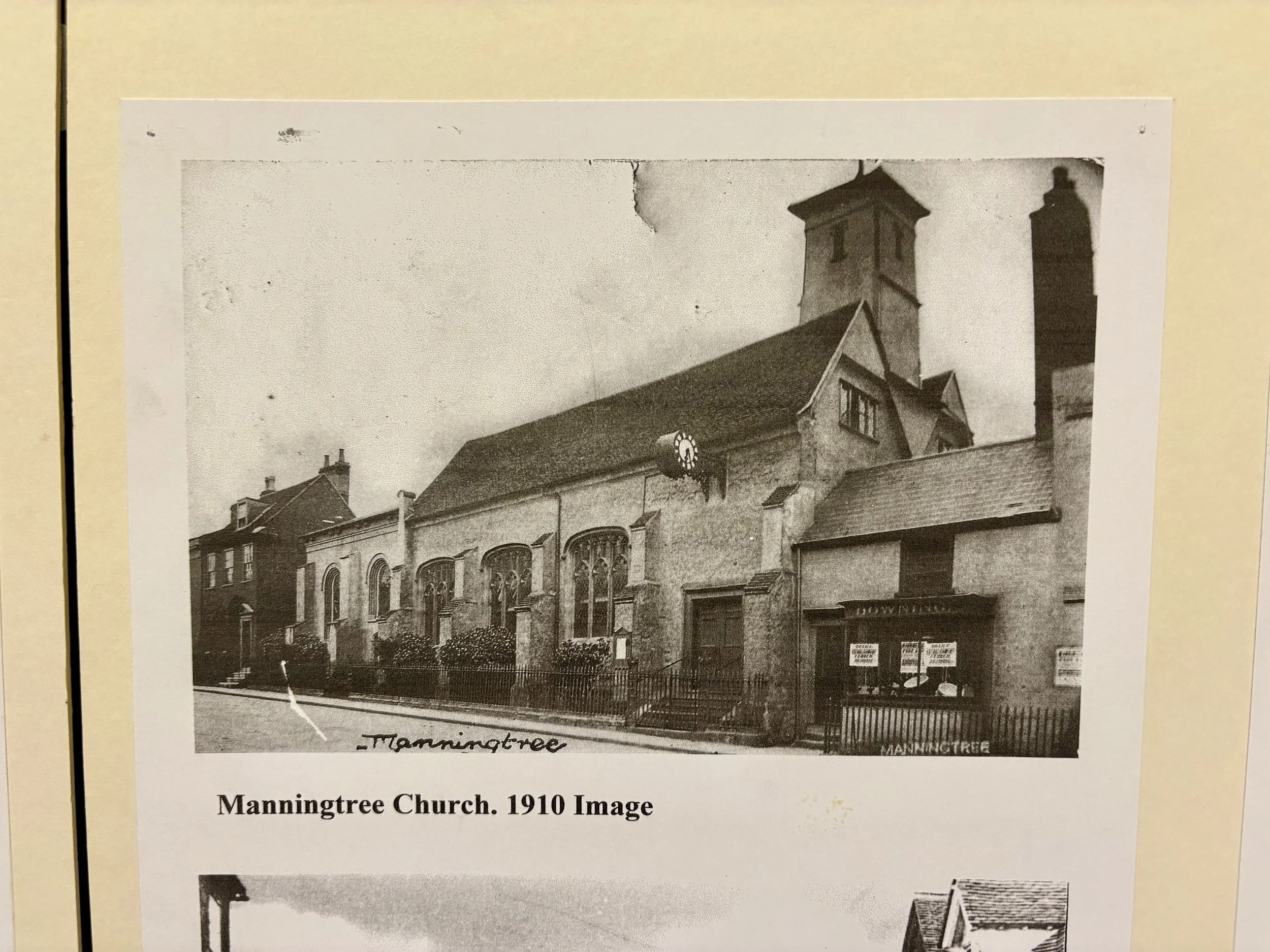
Photo of Church of St. Michael and All Angels, 1910, from the Manningtree Museum.
The church was torn down in 1966.
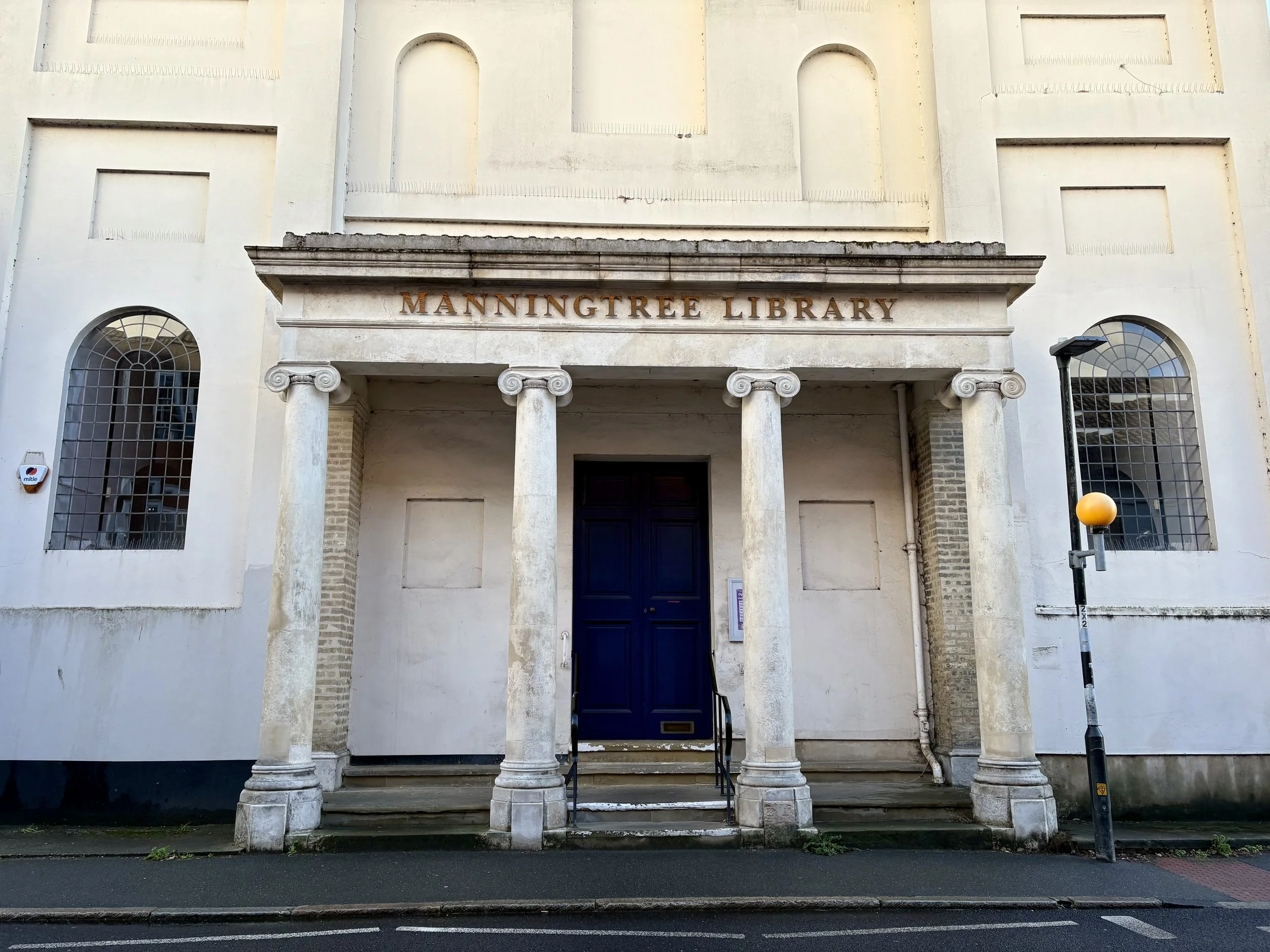
Manningtree Museum
The Manningtree Museum is located inside the Manningtree Library. It is a small, but well-researched museum and features displays related to the town’s history.
Visit the museum’s website for information about their opening times and displays.
Located on the High Street.
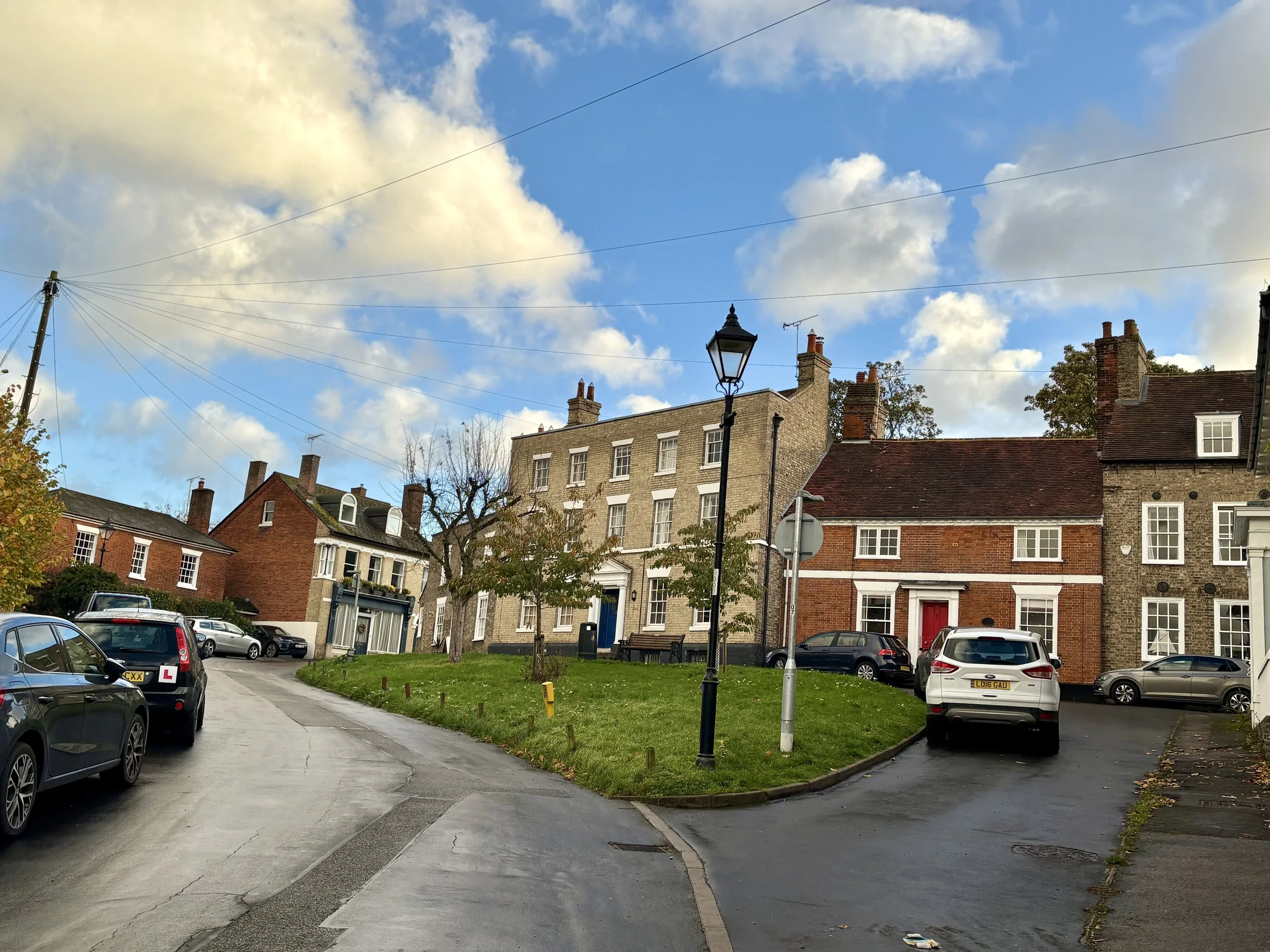
Village Green (Possible Execution Site)
No one knows exactly where the four women executed in Manningtree on August 1 1645 were hanged, but Alison Rowlands of the University of Essex has speculated the village green may have served as the execution site due to it’s central location. The women may have also been buried nearby.
Located on South Street near The Red Lion pub.
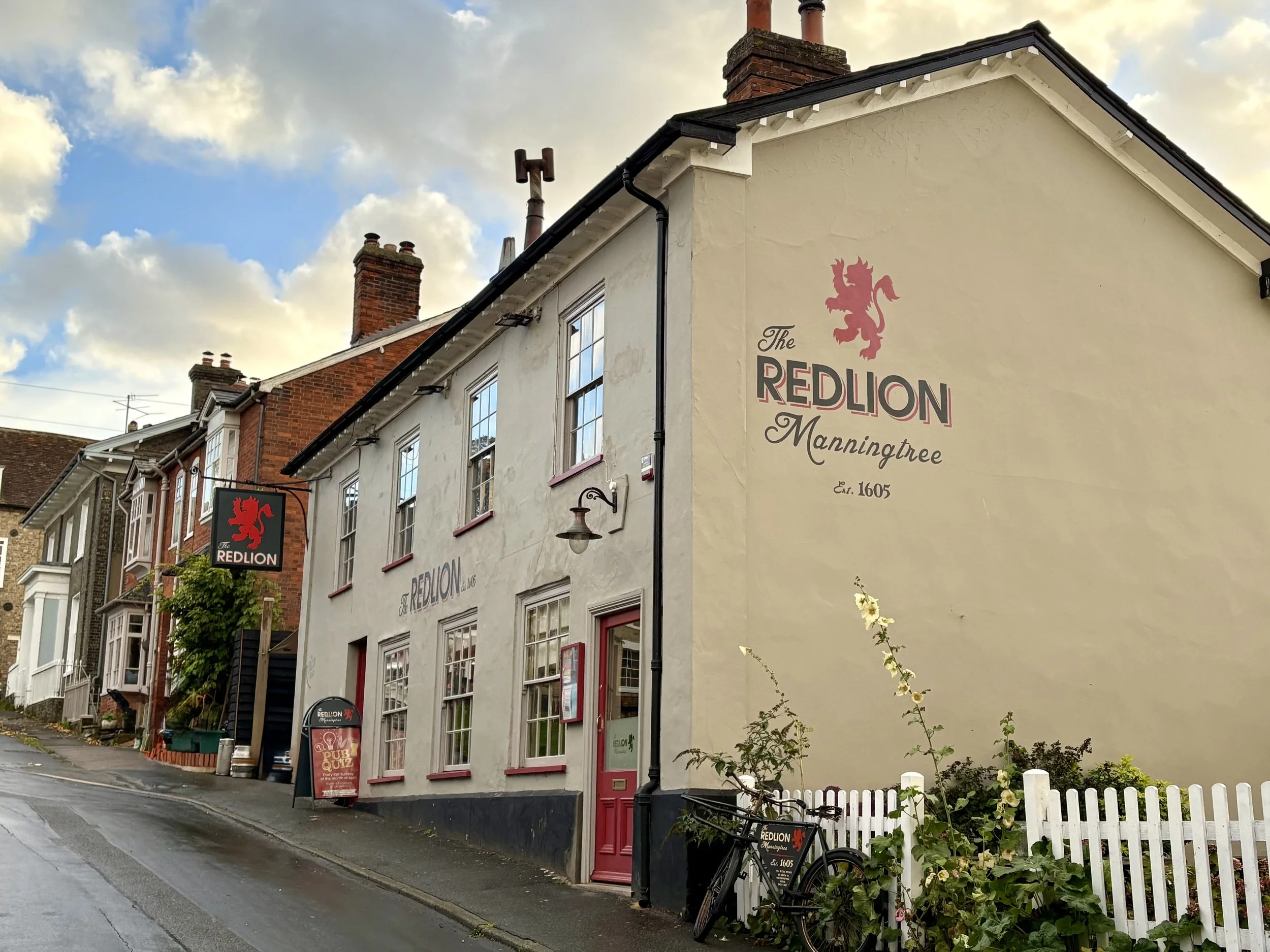
The Red Lion
The Red Lion is Manningtree’s oldest remaining pub, having been established in 1605.
It is one of a few pubs in the area that have claimed to be directly linked to Matthew Hopkins or the witch trials, with the Red Lion claiming that Elizabeth Clarke was arrested there, but this is more of a local legend than it is supported by historical evidence. It would have been standing in March 1645 as the initial investigations began in Manningtree, but we cannot be certain if or in what capacity it was frequented by those involved in the witch-hunt.
Located at 42 South Street.
The High Street and nearby avenues feature a number of cafes, shops, and independent book stores — many of which feature a copy of The Manningtree Witches by A.K. Blakemore or other books related to the town’s history.
Mistley
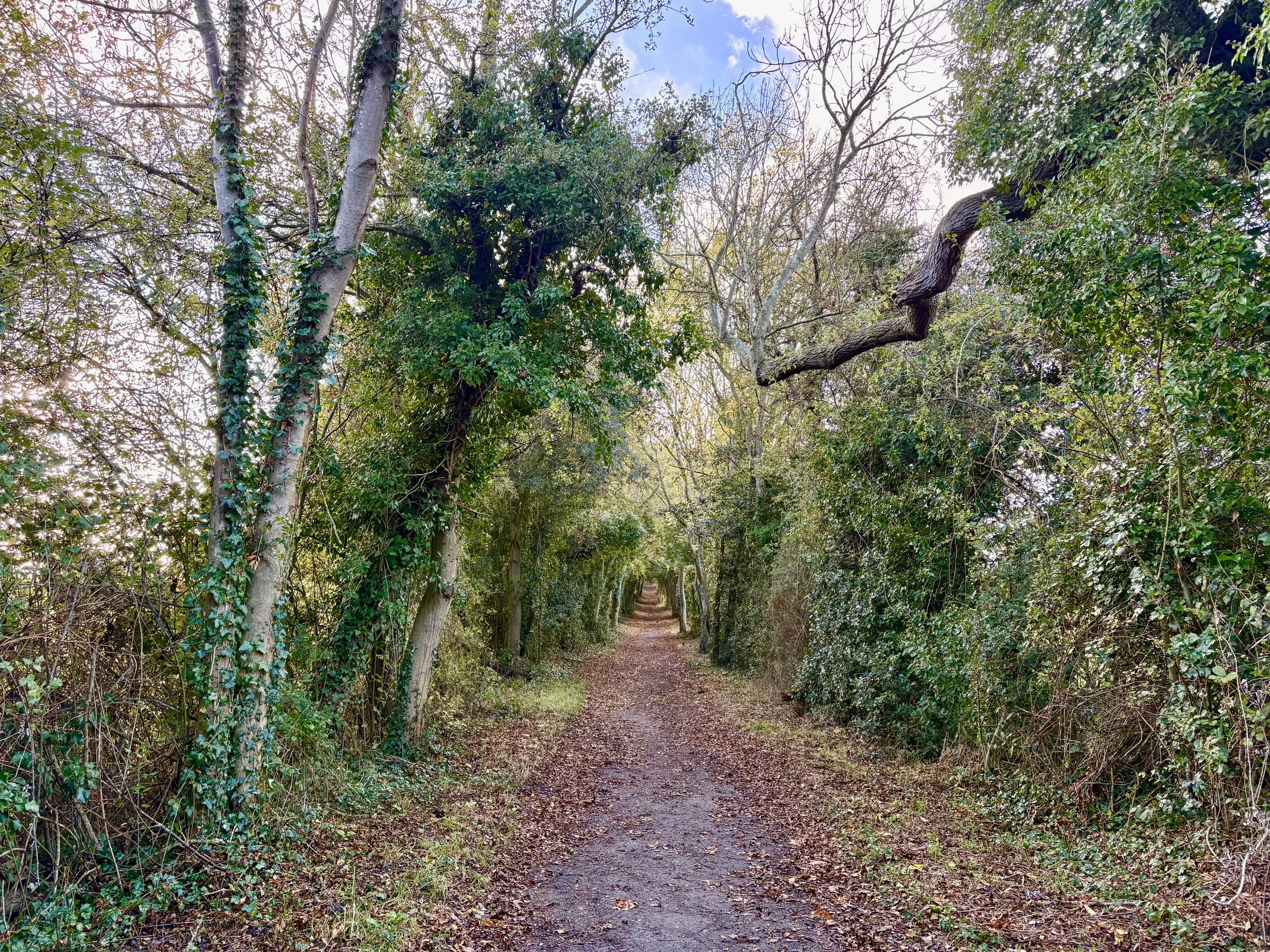
Mistley Heath
Matthew Hopkins moved to Mistley when his mother remarried to the Mistley rector, Thomas Witham. As a teenager he lived in the parsonage near the Mistley Heath church along with his new step-family.
This included a step-sister, Susan Witham, who would marry Richard Edwards, the Chief Constable of the Tendring Husband. Susan and her husband Richard had three or four children die within five years, a tragedy that left the grief-stricken parents convinced someone in Manningtree must be to blame for their misfortune. Susan and Richard Edwards, along with others in Manningtree including John Rivet, accused Elizabeth Clarke (and later other women) of bewitching their loved ones.
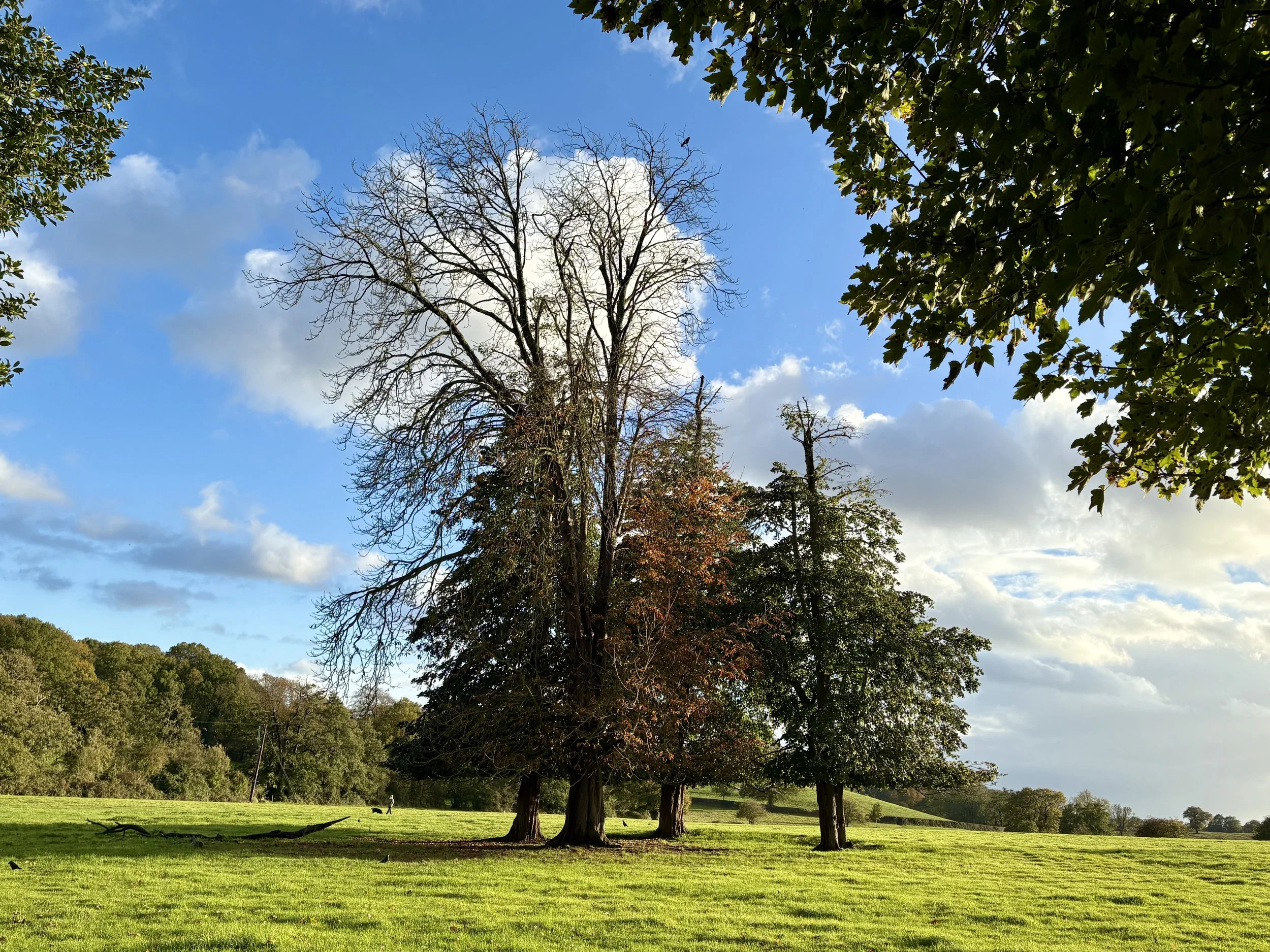
This means that Matthew Hopkins had a vested interest in Elizabeth Clarke’s interrogation because he believed that she had cursed his step-sister Susan’s family. His fascination with witchcraft would soon go beyond protecting his kin to hunting for witches far beyond Manningtree over the next two years.
Hopkins returned to Manningtree in 1647. By this time, he was dying of tuberculosis. He was buried in August 1647 in the Mistley Heath church’s graveyard. He was around twenty-seven years old.
There is a popular legend that Hopkins was ‘swum’ or executed as a witch, but this is not true.
The Mistley Heath church no longer exists. The St. Mary & St. Michael’s church that can currently be found on Mistley Heath is not the original church.
It is unknown exactly where on the heath Hopkins is buried. His grave, like those of his victims, has been lost.
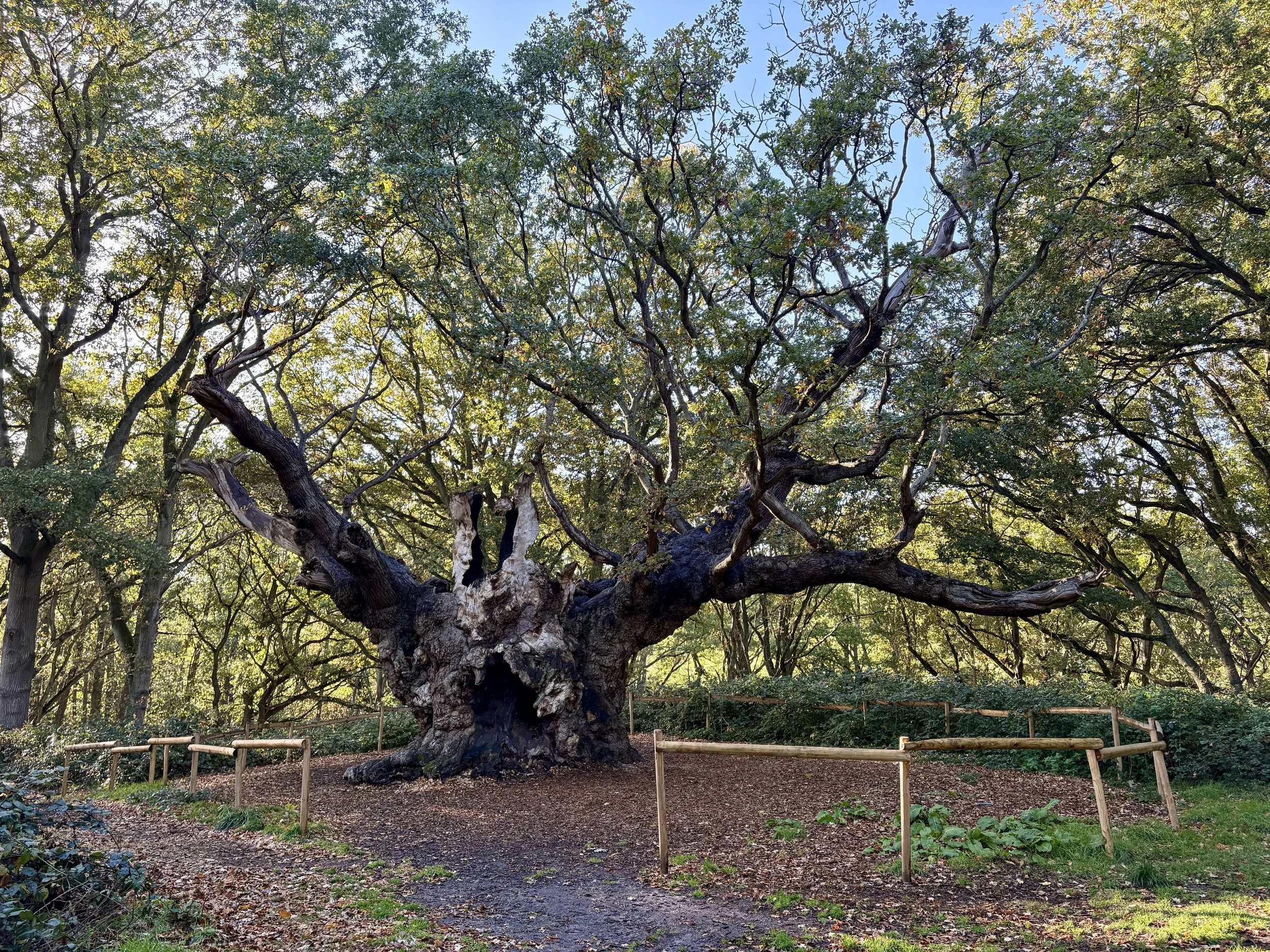
Old Knobbley (pictured) is an ancient oak tree estimated to be eight hundred years old. It would have been familiar to Hopkins who lived nearby and to the Manningtree and Mistley women who were accused of being witches in a coven.
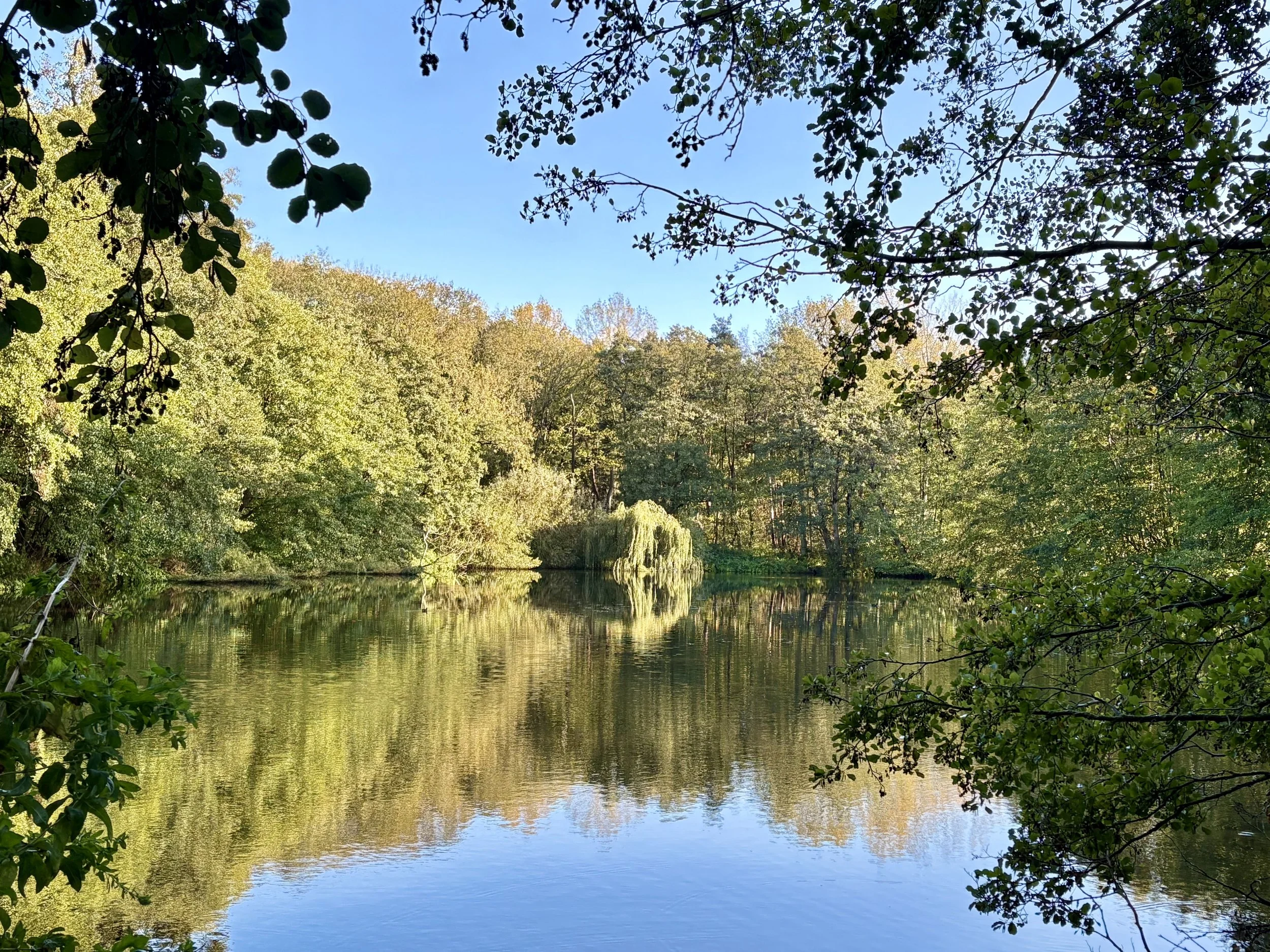
When the witchfinder John Stearne was considering whether or not to have Elizabeth Clarke ‘swum’ as a witch, he may have been considering doing so in one of the nearby bodies of water such as Gamekeeper’s Pond.
Local legend has it that Gamekeeper’s Pond is haunted by Matthew Hopkins. Voices do carry over the water in an eerie way.
Mistley Heath is approximately ten minutes from Mistley train station, and then a further ten to fifteen minutes to reach Old Knobbley and then the Gamekeeper’s Pond.
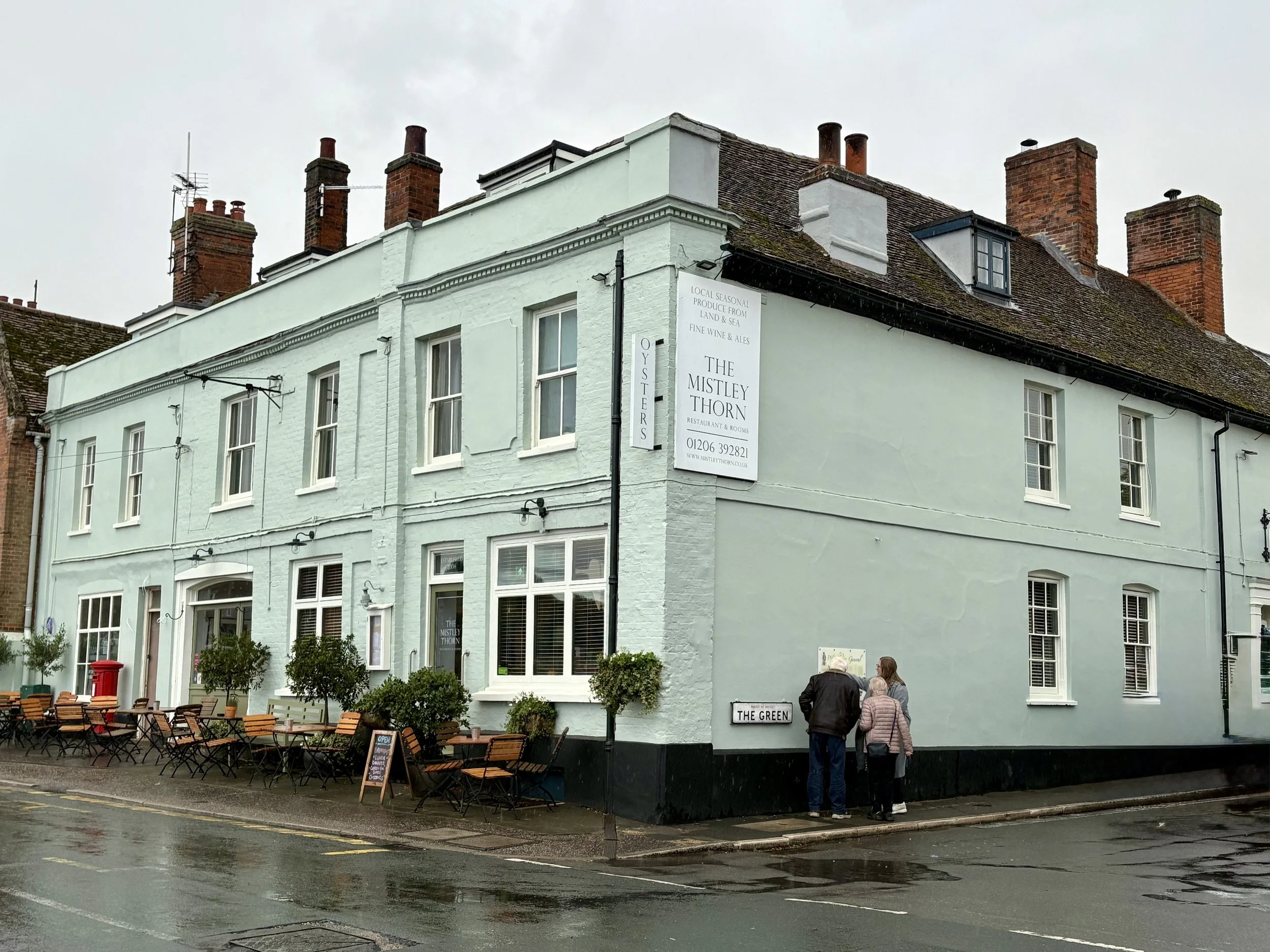
The Mistley Thorn
Another pub that local legend has connected to the witch-hunt, The Mistley Thorn claims that The Thorn Inn which previously stood on the site was once owned by Matthew Hopkins, but there is no evidence to prove this.
A plaque about Hopkins is located on the building’s side.
Located on the High St in Mistley about two minutes walk to the left of Mistley train station.
Mistley also features the Mistley Towers, the twin towers of the now demolished Church of St. Mary the Virgin. The structure was one of only two churches designed by Robert Adam. Only the towers remain today.
Lawford
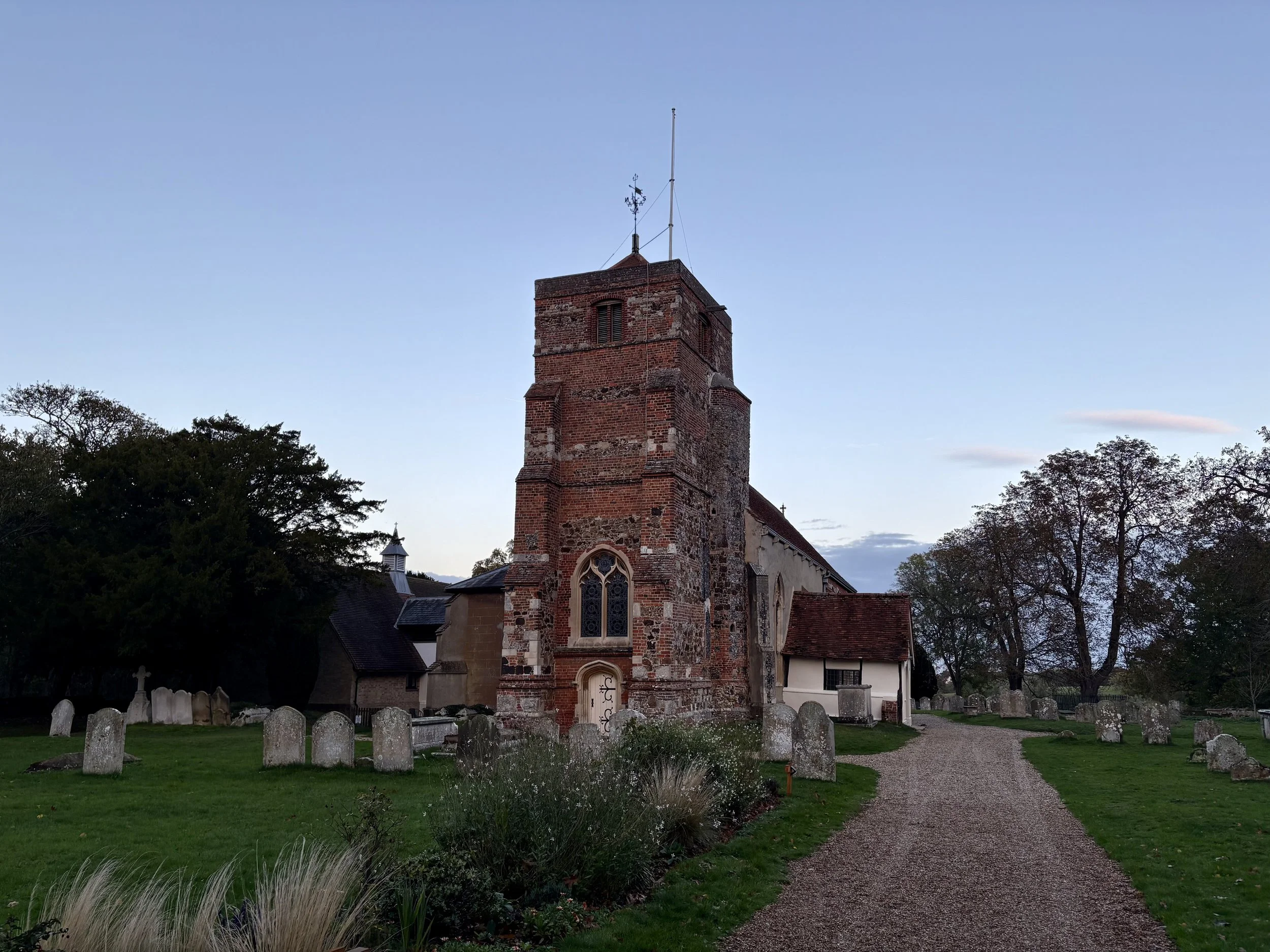
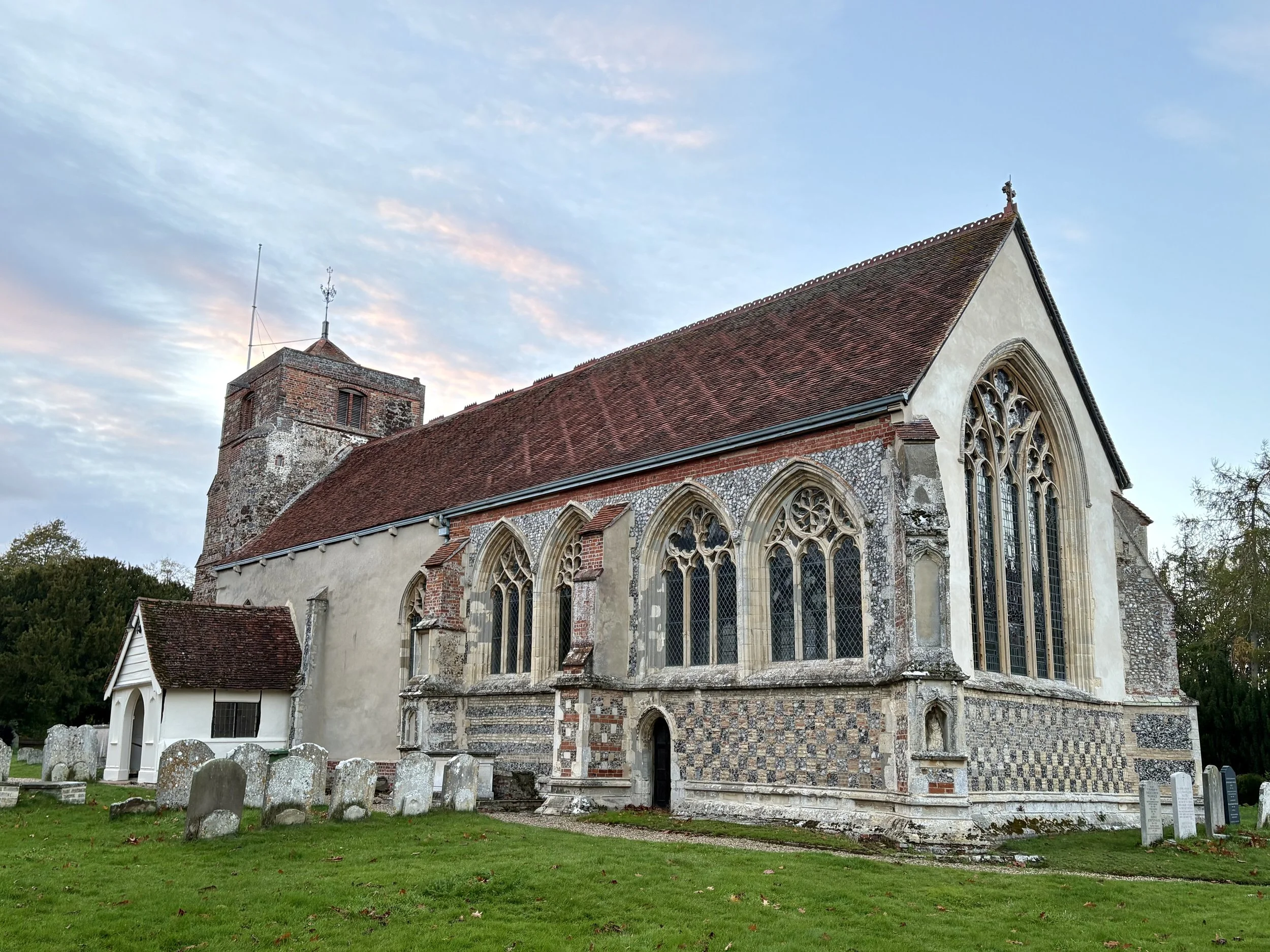
St Mary’s Church
St Mary’s at Lawford was the site of a shocking scene in February 1645 when five-months pregnant Prudence Hart left the service early due to severe abdominal pain. She collapsed on the half-mile walk home and had a stillbirth. Prudence blamed Anne and Rebecca West for the loss.
The rector of St. Mary’s, John Edes, interrogated Rebecca West and coerced her into confessing that both she and her mother were witches who plotted against Prudence Hart and her husband.
Anne West was executed at Manningtree on August 1 1645. Rebecca West was not made to plea on account of her turning prosecution witness. It is unknown what happened to her.
The church features a sign near the door explaining the church’s history, but it mistakenly refers to eight women being executed as witches in the July 1645 Chelmsford trials — the correct total is nineteen executed, fifteen at Chelmsford and four at Manningtree.
Located at the top of Church Hill, Lawford, approximately ten minutes walk from Church Hill bus station. There is a free car park at St. Mary’s.