The Forgotten Witchfinder
Matthew Hopkins, the “Witchfinder General”, is undoubtedly the most famous figure associated with the East Anglian witch trials —to the extent that most people don’t know that Hopkins was not the only witchfinder. There were the Essex magistrates Sir Harbottle Grimston and Sir Thomas Bowes who lent legal authority and support to the first investigations. There were also powerful local men, chief constables and ministers or other high status individuals, who sought to purge evil from their communities and without whom it would have been impossible to successfully ‘discover’ a witch.
And there was John Stearne, a prolific and dedicated witch-hunter. Much of what we know about the East Anglian witch trials comes from his demonology, A Confirmation and Discovery of Witchcraft, but ironically little attention has been paid to the man himself.
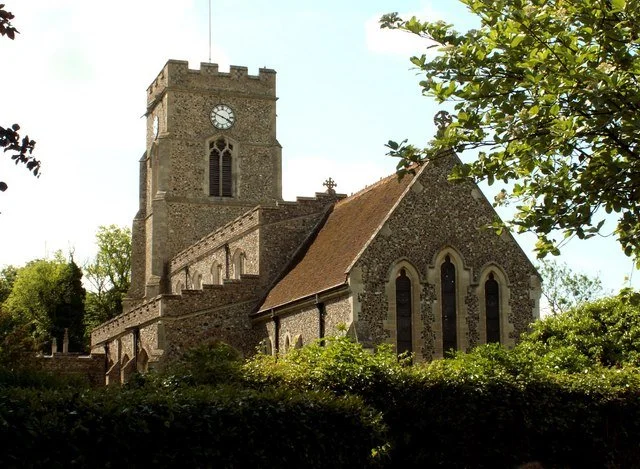
Pictured: All Saints at Lawshall.
John Stearne was a wealthy landowner, self described as a “plaine country man”, presumed to have been born around 1610 and in his mid thirties in 1645. He was from Suffolk, possibly born in Long Melford, but by 1645 split his time between his family residence in Lawshall near Bury St Edmunds and in Manningtree where he owned a house. His wife Agnes remained at Lawshall with their first child, a girl who had been baptized in 1644. His writing in A Confirmation suggests he was educated to some degree. and that he held a strong Puritan conviction.
Essentially, Stearne was doing very well for himself in 1645 as what might be considered a ‘young patriarch’ — an early modern man who had proven himself as a father and provider, of good character and social standing, but still lower-ranking and expected to defer to older men with more longterm established patriarchal status.
Why should such a man concern himself with witches? Stearne is not known to have had any personal connection to alleged victims of the Manningtree coven, as Matthew Hopkins was through his supposedly bewitched step-sister, Susan Edwards. Stearne also had a more well-defined identity and social status in comparison to Hopkins, who still occupied a vague and semi-juvenile position as an unmarried man without a career who was primarily identified through his connections to more powerful men, such as his deceased minister father, absent minister step-father, and wealthy step brother-in-law. Owning multiple properties in Essex and Suffolk and with a young child (and a second who would be conceived in the midst of his 1647 witch-hunting), Stearne surely had more immediate matters to be concerned with.
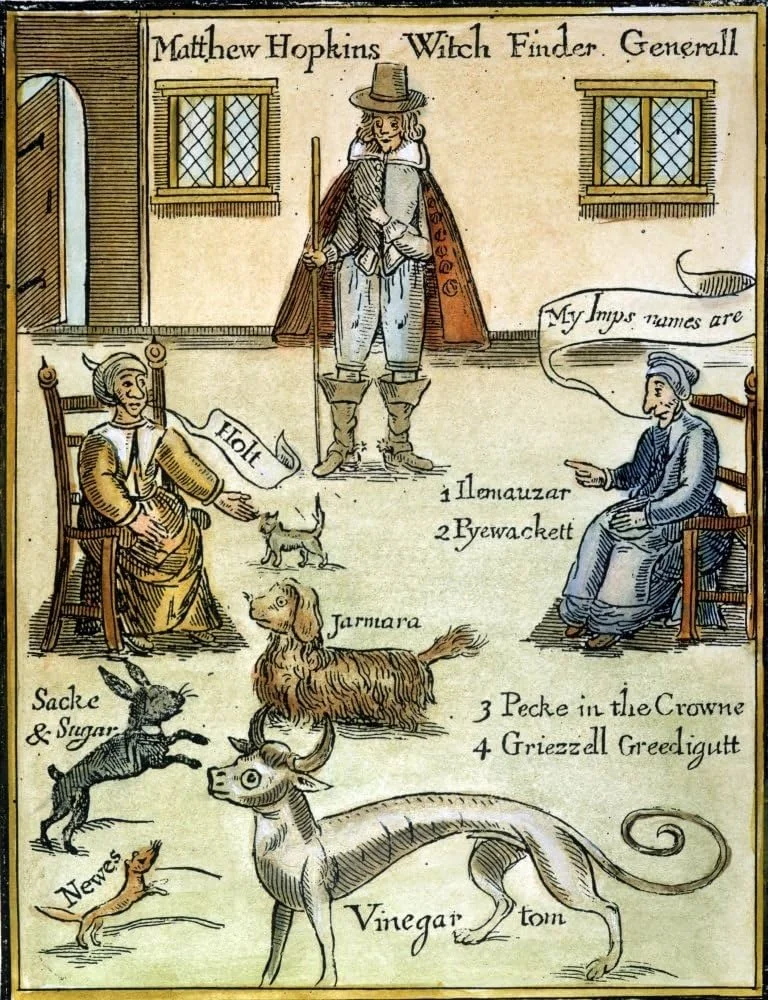
Pictured: colourized image of Stearne’s colleague Matthew Hopkins interrogating Elizabeth Clarke and another witch. Hopkins claimed all the credit for “discovering” Clarke in his The Discovery of Witches with no direct mention of Stearne. No contemporary image of John Stearne exists.
Stearne in A Confirmation regretfully does not explain why he became involved in witch-hunting, only noting that he was in Manningtree at the time the first suspected witch, Elizabeth Clarke, was being questioned. He stated he was one of a group of concerned townspeople who caused her to be questioned and that, at the insistence of the townspeople and with authorization from the local magistrates, he was put in charge of Clarke’s investigation.
Stearne appears to have been motivated by a combination of curiosity, self-importance, a tendency to involve himself in legal matters, and a genuine desire to protect his community from the threat of witchcraft.
He had at least a working knowledge of demonology (educated discourse on witchcraft) in 1645 as demonstrated in his first case with Elizabeth Clarke, where he displayed an awareness of “swimming” a witch, devil’s marks, imps, and the witch’s relationship with the Devil. He may have even heard of the alleged witch and journeyed to Manningtree specifically to volunteer for the investigation. Stearne did not have a legal background but he was not unfamiliar with a courtroom: he had been summoned as a witness for a theft in 1643 and in 1648 would complain of suits brought against him for his witchfinding and how he was considering counter-suing. He also was involved in legal disputes with his neighbours in the 1650s after he retired from witchfinding, all of which suggest he may have been the sort of man who viewed himself both as having knowledge of the law and as more than willing to take matters to court.
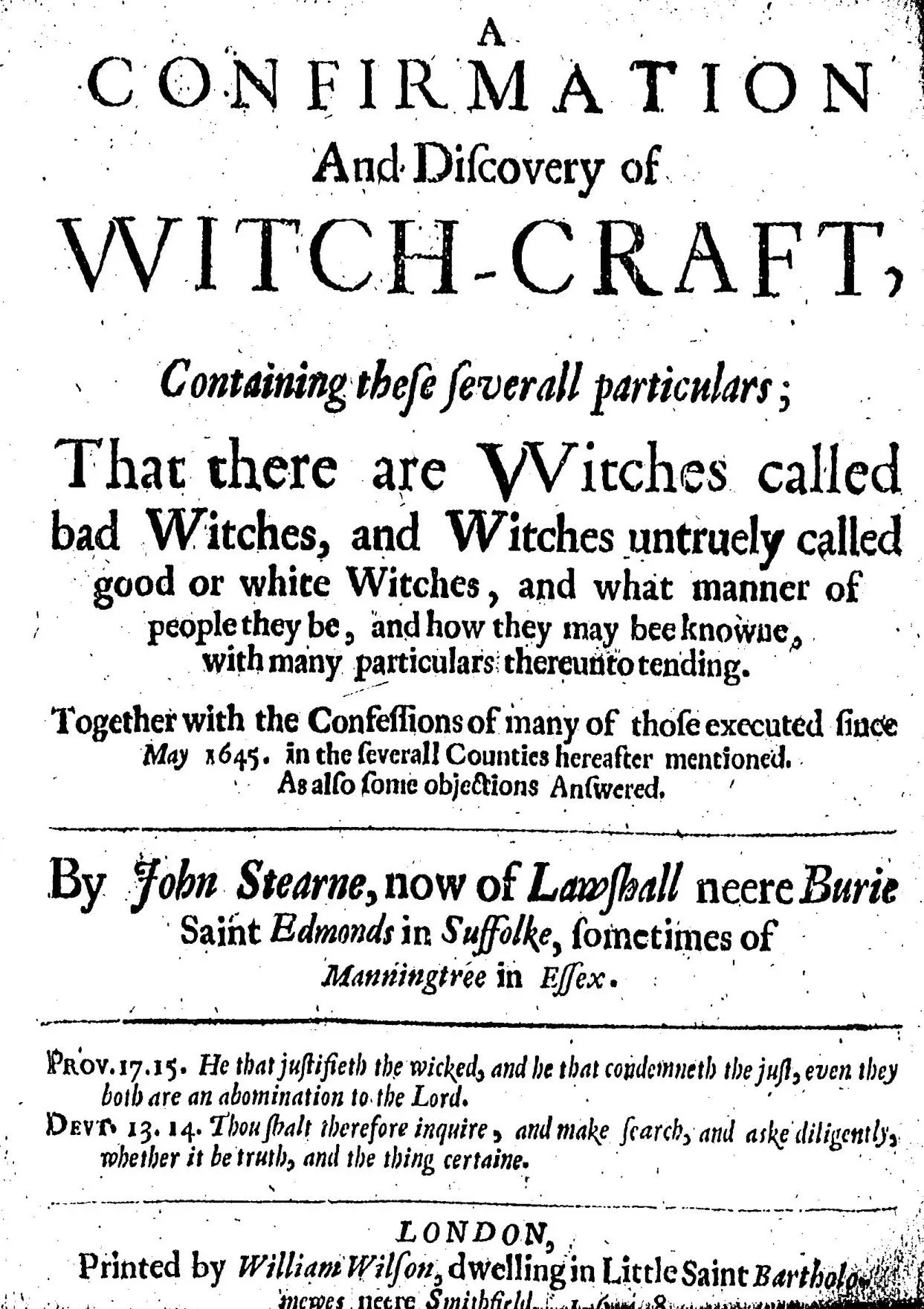
Pictured: front piece of A Confirmation and Discovery of Witchcraft
His demonology, A Confirmation and Discovery of Witchcraft, was published in 1648 as a defence of his witchfinding. By that point, mounting criticism had forced him to retire from witchfinding and Hopkins was dead from tuberculosis. A Confirmation was his attempt to show he had acted within the law, using (what he considered to be) established methodology, and that everything he had done was for the good of England. The text has a strong element of Stearne’s self-importance as he positions himself as a hero wrongfully condemned by critics when he should be praised for the good work he had done in ridding the countryside of evil. Stearne likely truly believed he had done a heroic, godly service for his community, which left him all the more embittered by the perceived ingratitude.
John Stearne and Matthew Hopkins worked closely together at the beginning of the witch-hunt in Essex in 1645. They were largely successful, but a scandal in Colchester resulted in Stearne being outlawed. Stearne and Hopkins then rode for Suffolk and parted ways, perhaps to cover more ground. They would occasionally meet over the next two years to collaborate but largely worked independently.
It is unclear how many suspects Stearne interrogated, but A Confirmation lists dozens of his personal encounters with alleged witches, usually as an independent witch-hunter rather than in collaboration with Hopkins. As such, though Hopkins is the more well-known and infamous of the pair, John Stearne’s role in furthering the East Anglian witch panic should not be overlooked.
Further reading.
Scott Eaton, John Stearne’s A Confirmation and Discovery of Witchcraft: Text, Context, and Afterlife, (Routledge: New York, 2020)
Essex Records Office Q/SR 320/59
Malcolm Gaskill, “Masculinity and Witchcraft in Seventeenth-Century England.” in Rowlands, A. (eds) Witchcraft and Masculinities in Early Modern Europe (London, 2009)
Malcolm Gaskill, Witchfinders: A Seventeenth-Century English Tragedy (Harvard University Press, 2005)
Matthew Hopkins, The discovery of witches (London, 1647)
John Stearne, A confirmation and discovery of witchcraft (London, 1648)