The Witchfinder General
The most well-known figure associated with the East Anglian witch trials is undoubtedly Matthew Hopkins, the “Witchfinder General”. Yet legend has obscured the truth of Hopkins’ origins.
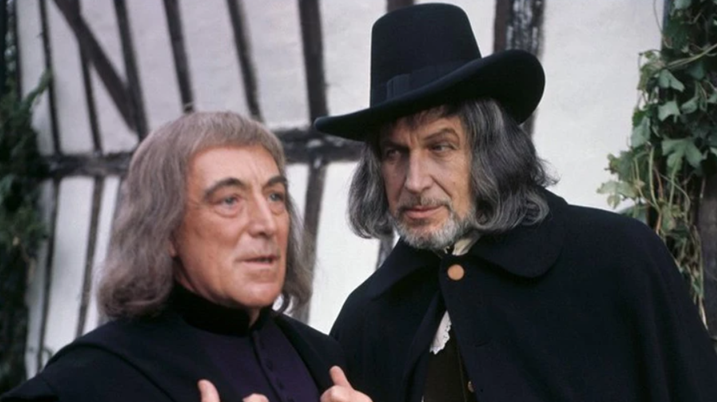
This is partially due to his popular portrayal by Vincent Price in the heavily fictionalized film Witchfinder General (pictured).
The waters are further muddied by a sensational ‘biography’ written by Richard Deacon that was allegedly based on a secret document Deacon discovered, but has since been proven to be a hoax and all of Deacon’s fanciful claims of Hopkins' being a Civil War spy and faking his death to flee to America entirely untrue. But even during Hopkins’ lifetime and not long after his death, he was seen as an infamous and shadowy figure rumoured to be in the Devil’s service or to have been executed as a witch.
The real Matthew Hopkins came from a wealthy Suffolk family with strong ties to Puritanism and the Church. The family’s money originated with Matthew’s grandfather, who acquired his wealth through purchasing land in Littleport that had once been public and charging for its use. James Hopkins, Matthew’s father, was educated at Cambridge and invested as the rector at Great Wenham. He and his wife, Marie, had six children. The boys were named for the Apostles: James, Thomas, John, and youngest son Matthew.
Matthew is thought to have been born around 1620, based on the wording of James Hopkins’ will.

Matthew Hopkins grew up near his father’s church, St John’s in Great Wenham (pictured).
James Hopkins was friends with John Winthrop, first governor of Massachusetts who desired to create a Puritan haven in the ‘New World’. In a letter to Winthrop, Hopkins lamented the “heathens” and “papists” that had infected England and expressed his desire to relocate with his family to Massachusetts. That he would risk the danger of the long crossing and resettlement indicates his strong faith.
James Hopkins would never see America. He died in January 1635 when Matthew was a teenager. His influence on his son Matthew can be seen in the latter’s intense religious conviction and belief in his own righteousness. James Hopkins left Matthew both a sizeable earthly inheritance of wealth and a spiritual inheritance, with the witchfinder John Stearne commenting after Matthew’s death in 1647 that Matthew was undoubtedly in heaven because he was the “son of a godly Minister”.

Marie Hopkins remarried Thomas Witham, rector of Mistley and Manningtree, and moved with the teenaged Matthew to a house near Mistley’s parish church. The marriage caused Matthew to gain several step-siblings, including Susan Witham, who became Susan Edwards when she married the local chief constable and wealthy landowner Richard Edwards.
Pictured: the rebuilt St Michael’s in Mistley. Not the original building that Thomas Witham preached at, but built near the original site.
Matthew did not attend Cambridge or enter the Church as his father, step-father, uncle, and eldest brother James had. By 1645, aged approximately twenty-five, he had received the money left to him by his father, but does not otherwise appear to have distinguished himself by career or through marrying and starting a family. There is little evidence for the commonly reported notion that he was a lawyer and no evidence he ever owned the Thorn Inn or any public house in Mistley or Manningtree. Matthew identified as a ‘gentleman’ and likely held a degree of high status as the son and step-son of Godly ministers, but by 1645 this was a tenuous link at best: his father had been dead for ten years and his step-father and mother had left Mistley by then. One of his brothers had died and his other siblings are not known to have lived near Mistley. By 1645, his closest family relations were his step-siblings, particularly his step-sister Susan and her powerful husband. That is to say that the twenty-five year old Matthew Hopkins occupied an ambiguous social status as a juvenile male of little apparent personal distinction, but with a strong religious background, and defined by his association with more high-status men.
By 1645, Susan and Richard Edwards had come to believe they were cursed. Elizabeth Clarke had allegedly killed their infant son, Matthew Hopkins’ step-nephew. While Matthew Hopkins would later claim it was he who first unmasked Elizabeth Clarke, it is likely that Elizabeth’s arrest was the work of a coalition of concerned locals including the Edwards and John Stearne, a landowner who seemed to involve himself in legal matters and had an interest in witchcraft.
Hopkins was likely the youngest of Elizabeth’s watchers and contemporary descriptions of his early involvement suggest an anxious, frightened, and fascinated young man out of his depth. He nervously asked if her imps would harm the watchers and how the Devil had appeared to Elizabeth. Elizabeth, in an apparent act of resistance, stated the Devil was a ‘properer’ man than Hopkins. One of the watchers then asked a very strange question of no demonological or legal value: would Elizabeth rather sleep with Hopkins or the Devil? Elizabeth said the Devil. This interaction is even more revealing in the context of Elizabeth having had an illegitimate child. Not only was Elizabeth possessed of secret magical knowledge, but also of sexual knowledge. It is very possible that Matthew Hopkins would have been the only one of the watchers present who was not married and thus had no such knowledge. While there is nothing outright to suggest sexual perversion, and such an argument does not fit with other evidence that more strongly suggests religious conviction and a sense of his own heroism as Hopkins’ primary motivations for witchfinding, it is very easy to imagine discussion of sexuality and women’s bodies (Elizabeth having been searched for ‘Devil’s marks’) as adding to Hopkins’ anxiety and discomfort as he aided the first investigation.
Hopkins left and visited his brother-in-law, presumably to report back on how the interrogation had went. He claimed in sworn testimony before the magistrates that he was then attacked by an imp, similar to a cat but bigger, but that his greyhound had chased it away. Two years later when he recounted the same story, his version of events had changed to an imp the size of a bear which he fended off by himself.
Hopkins’ was equal parts terrified and obsessed with witches. Elizabeth Clarke had directly compared him (unfavorably) to the Devil and she or other witches had sent a demon after him: and yet, he had survived, and had formed a new alliance with powerful men determined to root out evil. He was likely still the most junior member of this group of witchfinders, but soon proved himself through successfully convincing the confessed witch Rebecca West to testify she was part of a coven with Elizabeth Clarke and other women from or near Manningtree.
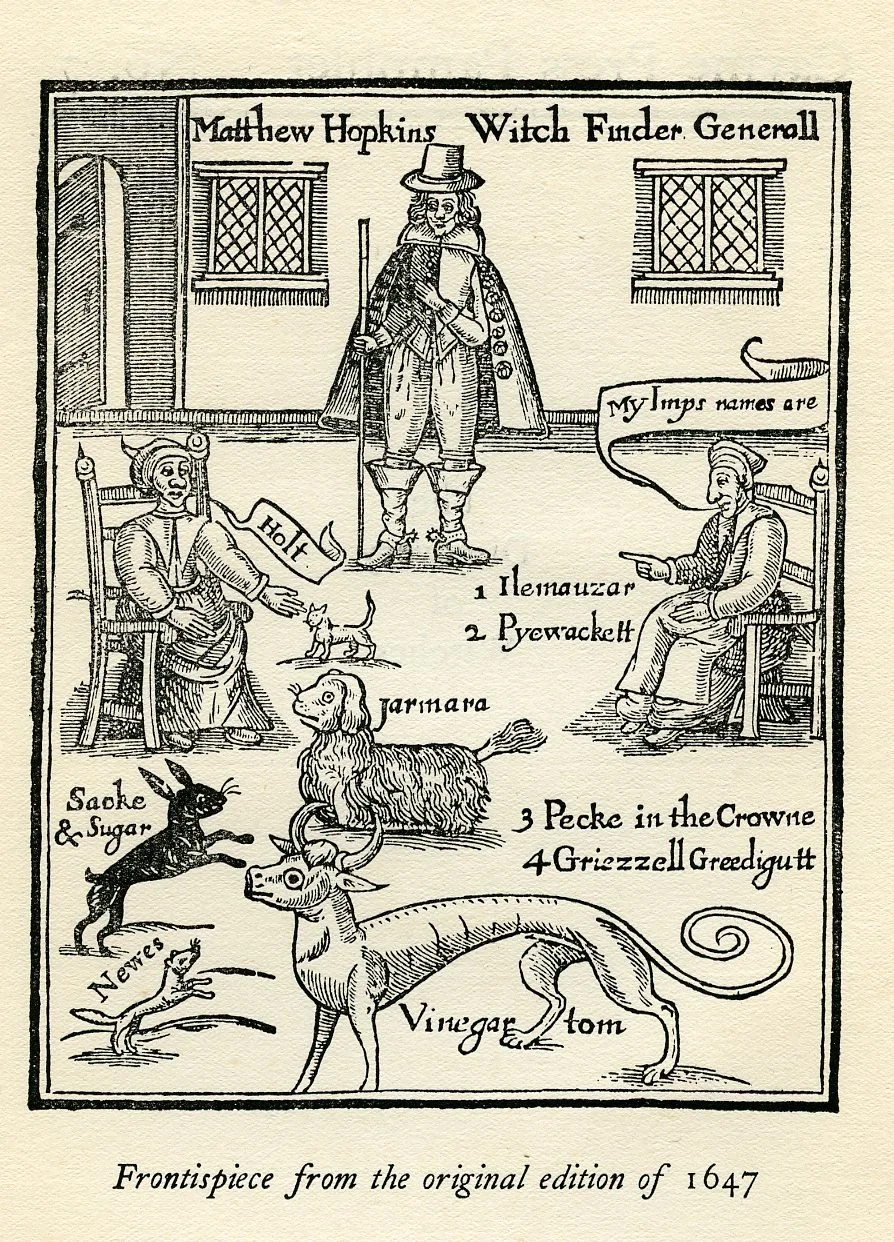
Pictured: woodcut from Matthew Hopkins’ The Discovery of Witches (1647) depicting him as the “Witch Finder Generall” with Elizabeth Clarke and another witch
Witchfinding offered Matthew Hopkins a new identity as a heroic witch-hunter battling, and winning, against the Devil’s army of witches. He need no longer cling to the coats of more powerful men but was worthy of respect and praise in his own right. It may have made him feel closer to his father as both men had believed themselves to be doing God’s work. He may also have known his time was short: he would die of tuberculosis in 1647, and it is possible he had already begun to feel the effects of it in 1645, and was desperate to leave his mark upon the world and prove he had earned his place in heaven.
As such, Hopkins did not return home with his step-sister Susan once the Manningtree coven were dead: he rode on to find and destroy evil throughout East Anglia.
Further reading.
A true and exact relation of the severall informations, examinations, and confessions of the late witches, arraigned and executed in the county of essex. (London, 1645)
C.L’Estrange Ewen, Witch Hunting and Witch Trials (London, 1929)
Malcolm Gaskill, “Masculinity and Witchcraft in Seventeenth-Century England.” in Rowlands, A. (eds) Witchcraft and Masculinities in Early Modern Europe (London, 2009)
Malcolm Gaskill, Witchfinders: A Seventeenth-Century English Tragedy (Harvard University Press, 2005)
Marion Gibson, Witchcraft: A History in Thirteen Trials, (Simon & Schuster UK, 2024), ch 5
Matthew Hopkins, The discovery of witches (London, 1647)
Papers of the Winthrop Family, Volume 3, 1633-02-25, Letter from James Hopkins to John Winthrop
James Sharpe, "Hopkins, Matthew (d. 1647), witch-finder." Oxford Dictionary of National Biography, (Oxford University Press, 2004)
John Stearne, A confirmation and discovery of witchcraft (London, 1648)
Frances Timbers, “Witches’ Sect or Prayer Meeting?: Matthew Hopkins Revisited”, Women’s History Review, vol 17 (2008)